


If you’re in the final weeks of pregnancy and have suddenly developed an intensely itchy rash, it’s understandable to wonder what is causing it and whether it could affect your baby. One possible cause is polymorphic eruption of pregnancy (PEP), which you may also see called PUPPP.
The rash often begins within stretch marks on your abdomen before spreading to areas such as your thighs or buttocks. Although the itching can be extremely uncomfortable, the reassuring news is that PEP itself does not normally harm your baby and usually settles after you give birth.
What Is Polymorphic Eruption of Pregnancy?
You may develop polymorphic eruption of pregnancy (PEP) as an itchy, raised rash during pregnancy. It often starts within the stretch marks on your abdomen and can gradually spread to other areas.
You may also know PEP as PUPPP, an older name still commonly used online. Although the itching can be severe, PEP is usually harmless, tends to settle on its own and does not normally pose a risk to your baby.
When During Pregnancy Does PUPPP Usually Appear?
You will most often develop PEP during the third trimester, particularly in the final weeks of pregnancy. You may suddenly notice itchy bumps appearing within your abdominal stretch marks as your skin stretches.
You can also develop PEP shortly after giving birth, so the rash does not always disappear immediately after delivery. If you develop severe itching earlier in pregnancy or without the typical abdominal pattern, you should speak to your doctor about other possible causes.
Why Does the Rash Often Begin in Stretch Marks?
You may first notice PEP as small pink or red bumps within your abdominal stretch marks. The exact reason is unclear, but rapid skin stretching may trigger inflammation, particularly later in pregnancy.
You may be more likely to develop PEP with twins or triplets, when your skin stretches more quickly. However, stretch marks do not directly cause the condition, as many pregnant women develop them without ever getting PEP.
What Might PUPPP Look and Feel Like?
PUPPP often begins as small, raised pink or red bumps sitting within the stretch marks on your abdomen. As the rash develops, these bumps can merge into larger swollen patches that look a little like hives.
One useful clue is that the skin immediately around your belly button is usually left clear. Small blisters can occasionally occur, but several or tense blisters are less typical and should be checked because another pregnancy-related condition may need to be ruled out.
Where Can the Rash Spread?
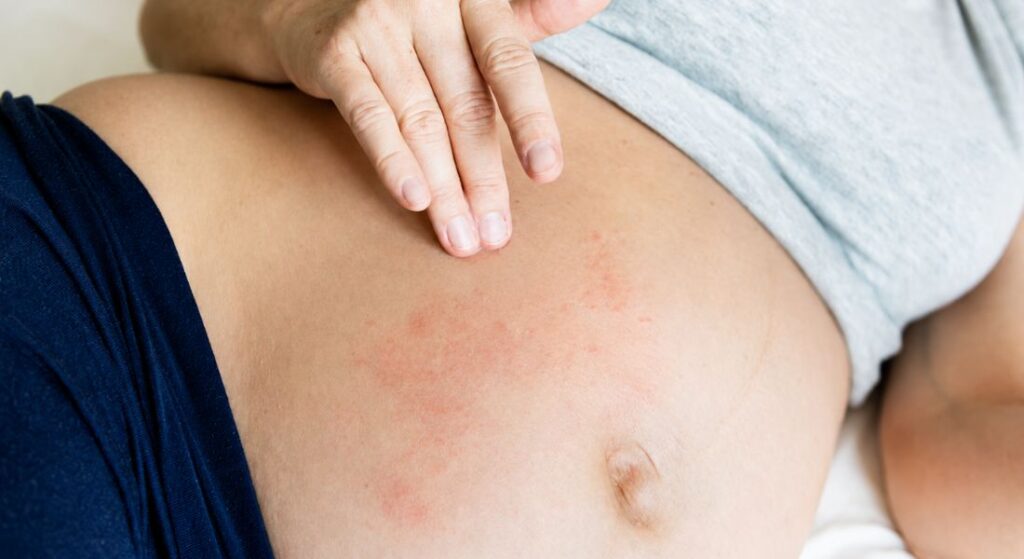
You may first notice the rash on your abdomen, but it can gradually spread to your buttocks, thighs, arms and lower legs. You may also see it under your breasts or across your trunk.
PEP rarely affects your face, scalp, palms, soles or genital area. If you develop several or tense blisters, particularly around your belly button, seek medical advice because pemphigoid gestationis may need to be considered. If your itching is very intense, affects your palms or soles, is worse at night or keeps you awake, contact your maternity unit or seek urgent medical advice, as these can be symptoms of intrahepatic cholestasis of pregnancy.
How Itchy Can Polymorphic Eruption of Pregnancy Become?
You may find PEP extremely itchy, especially at night when you are trying to sleep. Scratching can make your skin sore, red or crusted, while heat, tight clothing and warm showers may make the itching worse.
You should not dismiss severe itching simply because PEP is usually harmless. If the itching becomes intense or feels different from the usual rash pattern, tell your maternity team so they can check for other possible causes.
Who Is More Likely to Develop PUPPP?
You may be more likely to develop PEP during your first pregnancy or if you are carrying twins or triplets. Greater abdominal stretching may play a role, although the exact reason is not fully understood.
You may also come across suggested links with weight gain, birthweight or your baby’s sex, but these have not been consistently proven. Most importantly, developing PEP does not mean you did anything wrong during pregnancy.
Research Insight
A multicentre study of 181 women with polymorphic eruption of pregnancy found that 70% were experiencing their first pregnancy and 83% developed the condition late in pregnancy. A further 15% developed symptoms in the immediate postpartum period.
The same study found that the abdomen and upper thighs were affected in 97% of patients and that multiple pregnancies were more common than expected. However, fetal sex was not associated with the condition, supporting the view that some previously suggested risk factors remain uncertain.
Is PUPPP Dangerous for Your Baby?
You can usually feel reassured that PEP does not harm your baby. It generally does not mean you need an early delivery or caesarean section, and your usual pregnancy care can continue.
You should still tell your midwife, GP or maternity team about a new severe rash. Other conditions, such as intrahepatic cholestasis of pregnancy, can cause intense itching and may need different tests and monitoring.
UK Guidance Note
British Association of Dermatologists patient guidance describes polymorphic eruption of pregnancy as a benign pregnancy-associated rash that usually develops in the third trimester or immediately after birth. It commonly begins in abdominal stretch marks, usually spares the belly button and does not normally affect the baby or require a caesarean section.
However, severe itching during pregnancy should still be assessed because other conditions need different management. Intrahepatic cholestasis of pregnancy usually causes itching without a primary rash and is assessed with blood tests for bile acids and liver function, while blistering around the belly button raises concern about pemphigoid gestationis.
How Is Polymorphic Eruption of Pregnancy Diagnosed?
There is no single blood test that confirms PEP. Your doctor will usually make the diagnosis from the appearance and distribution of your rash, when it started and whether the area around your belly button is spared.
If the pattern is unusual, you may need blood tests or other investigations to rule out conditions that need different care. In some cases, particularly when pemphigoid gestationis is suspected, a skin biopsy may also be recommended.
Clinical Tip
Take photographs when your rash first appears and if its distribution changes. Showing where the eruption started, particularly whether it began within abdominal stretch marks or around the belly button, can help your doctor distinguish PEP from other pregnancy-related skin conditions.
Also mention whether you have severe itching without an obvious rash, itching of your palms or soles, or new blisters, because these features may change which investigations you need.
How Is PUPPP Different From Pemphigoid Gestationis?
You may notice that both conditions cause intense itching and a hive-like rash during pregnancy. PEP usually starts in your stretch marks while leaving your belly button clear, whereas pemphigoid gestationis often begins around the belly button.
You should seek medical advice if your rash develops large, tense blisters, as this is more suggestive of pemphigoid gestationis. Your dermatologist may recommend a skin biopsy with direct immunofluorescence to help confirm pemphigoid gestationis.
How Is PUPPP Different From Intrahepatic Cholestasis of Pregnancy?

You may confuse PEP with intrahepatic cholestasis of pregnancy (ICP) because both can cause intense itching. PEP causes a visible rash, while ICP usually causes severe itching without a primary rash, often affecting your palms or soles.
If your itching is very intense, is worse at night, affects your palms or soles or keeps you awake, contact your maternity unit or seek urgent medical advice. Blood tests can check your bile acids and liver function, as ICP can carry pregnancy risks that PEP does not.
How PEP, Pemphigoid Gestationis and ICP Can Differ
| Feature | PEP / PUPPP | Pemphigoid gestationis | Intrahepatic cholestasis of pregnancy |
| Primary problem | Inflammatory pregnancy rash | Autoimmune blistering disease | Pregnancy-related liver disorder |
| Typical skin finding | Itchy papules and plaques | Urticarial eruption that can progress to tense blisters | Usually no primary rash |
| Where it often starts | Abdominal stretch marks | Often around the belly button | Itching may be widespread, often palms and soles |
| Belly button | Usually spared | Often involved | No characteristic rash |
| Blisters | Small vesicles can occasionally occur | Larger or tense blisters are characteristic as disease develops | No primary blisters |
| Main investigation | Usually clinical diagnosis | Skin biopsy with direct immunofluorescence | Bile acids and liver-function tests |
| Risk to baby | Generally no recognised adverse fetal effect | Increased risk of premature delivery and a baby being smaller than expected; closer obstetric monitoring may be needed | Risk varies, particularly according to bile-acid level and other pregnancy risk factors |
| Treatment | Emollients, topical steroids, suitable antihistamines; rarely oral steroids | Specialist dermatology/obstetric treatment | Specialist maternity management |
What Treatments Can Relieve the Itching?
You can often ease the itching with regular moisturiser, cool baths or wet soaks. If the rash is more inflamed, your clinician may recommend a topical corticosteroid considered suitable for use during pregnancy.
You may also be offered an antihistamine if the itching is affecting your sleep. You should check with your GP, pharmacist or maternity team before taking any medicine during pregnancy.
What Happens if Your Rash Is Severe?
If PUPPP itching becomes severe, you may need stronger treatment to control your symptoms and help you sleep.
- Stronger treatment: Your doctor may consider additional treatment if creams and moisturisers are not enough.
- Oral steroids: A short course may sometimes be used for particularly severe symptoms.
- Early delivery: Severe PUPPP alone does not usually mean you need to deliver your baby early.
- Reassessment: Blisters, fever or feeling unwell should prompt another medical review.
Your treatment will depend on how severe your symptoms are and whether the rash still fits the typical pattern of PUPPP.
What Can You Do at Home to Make Your Skin More Comfortable?
You can ease itching by keeping your skin cool and choosing lukewarm showers instead of hot ones. Loose cotton clothing, an unperfumed emollient and cold compresses may also help soothe your skin.
You should avoid adding lots of fragranced or herbal products, as these may irritate your skin further. If the itching is severe, spreading quickly or affecting your sleep, you should speak to your healthcare team.
How Long Does PUPPP Last After Delivery?
You will usually find that PEP starts to settle after delivery, although your skin may not clear immediately. For most women, the rash improves and resolves within a few weeks after giving birth.
You can usually breastfeed if you have PEP, as the condition itself does not affect breastfeeding. If your rash continues for much longer, gets worse or changes in appearance, you should speak to your doctor for another assessment.
When Should You See a Dermatologist About a Pregnancy Rash?
You should seek medical advice if your pregnancy rash is severe, unusual or difficult to control. Several or tense blisters also need prompt assessment. If your itching is very intense, keeps you awake, is worse at night, affects your palms or soles or occurs without an obvious rash, contact your maternity unit or seek urgent medical advice because intrahepatic cholestasis of pregnancy may need to be ruled out.
If your PEP symptoms remain difficult to control, a dermatologist can help confirm the diagnosis and recommend suitable treatment. Your dermatologist and maternity team can work together when needed.
Myth vs Fact
| Myth | Fact |
| Any severe itching late in pregnancy is PUPPP. | No. ICP, pemphigoid gestationis and other conditions can also cause severe itching. |
| PEP always affects the belly button. | No. The umbilicus is typically spared. |
| PUPPP harms the baby. | PEP itself is generally benign and is not associated with the fetal risks seen with some other pregnancy dermatoses. |
| Blisters are always normal PUPPP. | Small vesicles can occasionally occur, but several or tense blisters require assessment for pemphigoid gestationis. |
| Every person with PEP needs oral steroids. | No. Emollients, topical corticosteroids and suitable antihistamines are usually sufficient; oral steroids are reserved for severe cases. |
| PEP always disappears the moment you give birth. | No. It generally improves after delivery but may take several weeks to fully clear. |
| Severe itching on the palms and soles can safely be assumed to be PUPPP. | No. This pattern should prompt assessment for intrahepatic cholestasis of pregnancy. |
Key Takeaways
- PUPPP is the older name for polymorphic eruption of pregnancy, or PEP.
- PEP usually develops in the third trimester and often starts within abdominal stretch marks.
- The belly button is usually spared, while the rash may spread to the thighs, buttocks, trunk or limbs.
- PEP can cause severe itching but is generally benign and does not normally harm the baby.
- Large or tense blisters, particularly around the belly button, require assessment for pemphigoid gestationis.
- Severe itching without a primary rash, especially on the palms or soles, should prompt assessment for intrahepatic cholestasis of pregnancy.
- Treatment usually focuses on symptom relief with emollients, appropriate topical corticosteroids and pregnancy-suitable antihistamines; oral corticosteroids are reserved for severe cases.
- PEP usually settles after delivery, although complete resolution can take several weeks.
Frequently Asked Questions
1. What is PUPPP rash during pregnancy?
PUPPP, also known as polymorphic eruption of pregnancy (PEP), is an intensely itchy rash that usually develops during the third trimester. It often begins in your abdominal stretch marks and may spread to other areas.
2. When does PUPPP usually appear?
You will most often develop PUPPP during the third trimester, particularly in the final weeks of pregnancy. It can also appear shortly after you give birth.
3. What does PUPPP rash look like?
You may notice small, raised pink or red bumps within your abdominal stretch marks. These can join together into larger, swollen patches that may look similar to hives.
4. Where does PUPPP rash usually spread?
PUPPP can spread from your abdomen to your buttocks, thighs, arms, lower legs, under your breasts and across your trunk. It rarely affects your face, scalp, palms, soles or genital area.
5. Is PUPPP dangerous for your baby?
No. PUPPP is generally harmless and does not usually affect your baby. It also does not normally mean that you need an early delivery or caesarean section.
6. Why does PUPPP start in stretch marks?
The exact cause is not fully understood, but rapid stretching of your skin may trigger inflammation. You may be more likely to develop PUPPP if you are carrying twins or triplets.
7. How is PUPPP diagnosed?
Your doctor will usually diagnose PUPPP by examining your rash and considering when it started and where it appeared. Blood tests or other checks may be needed to rule out conditions with similar symptoms.
8. How can you relieve PUPPP itching?
You can try regular moisturiser, cool baths, cold compresses and loose cotton clothing. Your clinician may also recommend a topical corticosteroid or antihistamine considered suitable for use during pregnancy if needed.
9. How long does PUPPP last after giving birth?
Your rash will usually start to settle after delivery and generally clears within a few weeks. If it continues, worsens or changes, you should speak to your doctor.
10. When should you see a doctor about PUPPP?
You should seek medical advice if your rash is severe, unusual or difficult to control. Large or tense blisters should also be assessed. If your itching is very intense, is worse at night, affects your palms or soles or occurs without an obvious rash, contact your maternity unit or seek urgent medical advice because intrahepatic cholestasis of pregnancy may need to be ruled out.
Final Thoughts: PUPPP Rash in Pregnancy
PUPPP can make the final weeks of pregnancy particularly uncomfortable, but you can usually feel reassured that it is generally a benign condition and does not normally affect your baby. Keeping your skin cool, using regular moisturiser and following the treatment recommended by your healthcare team can help you manage the itching while the rash settles.
If you’d like to arrange a consultation with one of our dermatologists in London, you can contact our team at the London Dermatology Centre.
References:
- Rudolph, C.M. et al. (2006) ‘Polymorphic eruption of pregnancy: clinicopathology and potential trigger factors in 181 patients’, British Journal of Dermatology, 154(1), pp. 54-60. Available at: https://pubmed.ncbi.nlm.nih.gov/16403094/
- Azziz, R. et al. (2009) ‘The Androgen Excess and PCOS Society criteria for the polycystic ovary syndrome: the complete task force report’, Fertility and Sterility, 91(2), pp. 456-488. Available at:
https://pubmed.ncbi.nlm.nih.gov/18950759/ - de Carvalho, M.L.R., Magalhães, G.M. and Leite, H.V. (2023) ‘Update on specific dermatoses of pregnancy’, Revista da Associação Médica Brasileira, 69(Suppl 1), e2023S109. Available at: https://pmc.ncbi.nlm.nih.gov/articles/PMC10411713/
- Alhomieed, M.F. et al. (2025) ‘The effect of pregnancy on dermatological disorders: a systematic review’, Clinical Practice, 15(4), 68. Available at: https://www.mdpi.com/2039-7283/15/4/68
- Armata, I. and Prakash, A. (2024) ‘An update on the assessment and management of hirsutism’, Obstetrics, Gynaecology & Reproductive Medicine, 34(6), pp. 169–176. Available at: https://www.sciencedirect.com/science/article/pii/S1751721424000137