



If you’ve ever wondered why acne scars seemed easier to handle when you were younger or why breakouts in adulthood leave more stubborn marks, you’re not imagining it. Acne scarring in adults behaves differently from acne scarring that forms in your teenage years and understanding those differences can help you make sense of why certain treatments work better than others. Many adults feel confused and frustrated when scarring feels harsher or more resistant, especially if they didn’t scar much as teenagers.
In this article, I want to walk you through why adult acne leads to different scar patterns, why the inflammation behind adult acne behaves differently, how hormones and lifestyle shifts change the way your skin heals, and why dermatologists take a completely different approach when creating a treatment plan for adult-onset scars.
Why Adult Acne Creates Scars More Easily Than Teenage Acne
Many people assume that scarring is directly related to the severity of acne, but in reality, it’s largely a matter of how the skin heals. Teenagers may have aggressive breakouts, yet their skin often repairs itself quickly, thanks to thicker, healthier collagen and a fast healing response. This is why many adolescents develop only a few scars despite frequent acne.
Adult skin, however, heals differently. It has reduced collagen, slower cellular turnover, lower elasticity, more accumulated sun damage, and weaker structural support. These changes make it harder for the skin to recover fully after inflammation, leaving it more susceptible to scarring even from smaller breakouts.
Because of these factors, adult acne scars often form more aggressively. The skin is essentially fighting a tougher battle against inflammation, which can lead to visible scars developing more easily and taking longer to improve without targeted treatment.
Why Teenagers Scar Less Even When Acne Is Severe
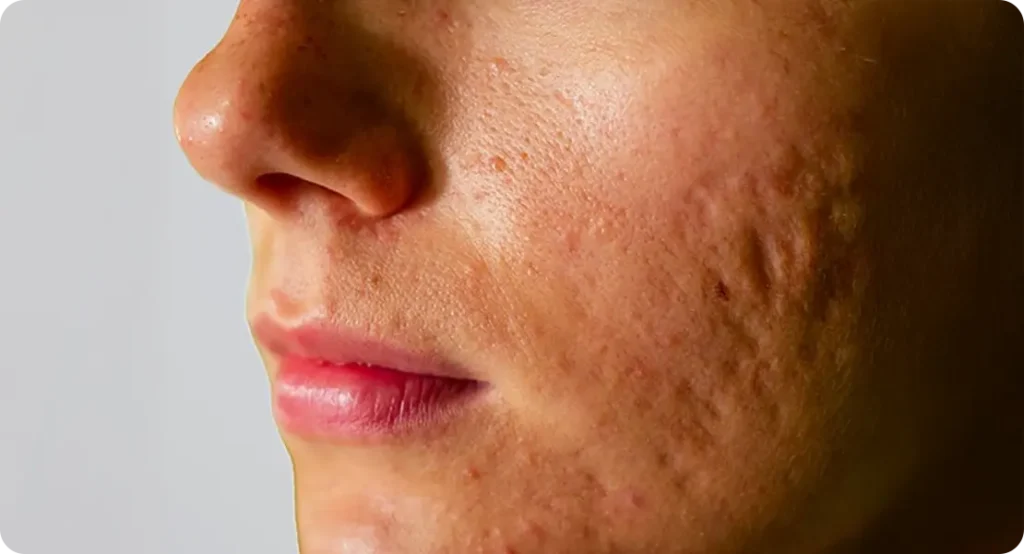
Teenage skin naturally regenerates at a much faster pace. Your fibroblasts the cells responsible for collagen are more active. The collagen fibres are stronger, denser, and more resilient. This gives teenage skin the ability to withstand severe inflammation without losing as much tissue.
When a teenage breakout heals, collagen rebuilds quickly and efficiently. Even deeper inflammation is usually repaired without leaving noticeable depressions. The skin simply has more biological resources available.
It’s not that teenage acne is “milder.” It’s that teenage skin has a biological advantage. Many adults are shocked to see scarring appear after relatively small breakouts because they expect their skin to behave the same way it did years ago. But the healing process changes with age.
Inflammation Works Differently in Adults
Acne scarring in adults often looks more pronounced and stubborn than in teenagers, and the reason lies in how adult skin responds to inflammation. Unlike younger skin, which can recover quickly, adult skin experiences longer lasting and deeper inflammatory reactions. Understanding these differences helps explain why adult scars are often sharper, deeper, and more challenging to treat.
In adults, inflammation:
- Lasts longer: Adult skin often maintains an inflammatory response for extended periods, increasing the risk of deeper tissue damage.
- Produces more tissue damage: Prolonged inflammation can break down collagen and elastin more extensively than in teenage skin.
- Triggers stronger immune responses: The immune system may overreact, causing more pronounced disruption in the dermis.
- Disrupts collagen architecture more easily: The structural framework of the skin is compromised, leading to depressions and irregularities.
- Lingers deeper in the dermis: Even after surface breakouts have healed, the underlying tissue may continue to be affected for several weeks.
In contrast, teenage inflammation often resolves quickly, preventing significant structural damage. This mismatch between surface healing and deeper tissue recovery explains why adult acne scars often appear sharper, deeper, and more persistent.
Hormones Change the Way Your Skin Reacts
Teenage acne is usually driven by sudden hormone surges during puberty, but adult acne is influenced by fluctuating hormones, which affect the skin in very different ways. These hormonal shifts in adulthood can slow healing, increase oil production while causing dryness, heighten sensitivity, trigger stronger inflammation, and create cyclical breakouts that overlap.
Many women experience hormonal acne related to menstrual cycles, pregnancy, post-pregnancy changes, perimenopause, or conditions like PCOS. These fluctuations often lead to breakouts that form deeper in the skin, which significantly raises the risk of scarring compared with more superficial teenage acne.
Adult acne commonly appears on the lower face, jawline, chin, and neck. The deeper, cystic nature of these breakouts makes them particularly prone to forming rolling, boxcar, and ice-pick scars, highlighting why adult acne requires careful, targeted treatment.
Why Adults Often Develop Ice-Pick Scars More Frequently
Teenagers usually develop surface-level scars because their acne inflammation is mostly confined to the upper layers of the skin. In adults, acne is often deeper and cystic, which makes them more prone to developing ice-pick scars.
Ice-pick scars occur when inflammation penetrates deeply into the dermis, destroying collagen in a narrow column and leaving sharp, narrow pits that resemble needle marks. Adults are more susceptible to these scars due to deeper inflammation, slower healing, hormonal cysts, chronic micro-inflammation, and previous sun damage that weakens the skin.
These scars are particularly stubborn because they cannot be effectively treated with general resurfacing techniques. Targeted treatments, such as TCA CROSS, are usually required to achieve meaningful improvement in ice-pick scarring.
Why Adult Skin Heals Slower

Adult acne often leaves more noticeable and persistent scars compared with teenage breakouts. This is largely due to differences in how adult skin repairs itself. Healing is slower, collagen production is reduced, and the skin’s ability to recover from inflammation is diminished, creating a higher risk of lasting depressions or irregularities.
Adult skin tends to have:
- Reduced fibroblast activity: Fibroblasts are the cells that produce collagen; fewer active fibroblasts mean slower tissue repair.
- Fewer collagen fibres: With less collagen available, the skin struggles to rebuild a smooth, even structure.
- Slower turnover of cells: Skin cell renewal takes longer, delaying surface healing and leaving scars more likely.
- Weaker blood supply: Limited circulation reduces nutrient and oxygen delivery, which is essential for effective healing.
- Increased oxidative stress: Free radicals and environmental damage can further impair repair and degrade existing collagen.
When healing is slow, the window for scarring widens. Instead of rebuilding collagen quickly, the skin may leave behind gaps, depressions, or tethered tissue. This is why adults can develop noticeable scars even after relatively small breakouts the healing process is simply not fast enough to fully counteract the inflammatory damage.
The Role of Sun Damage in Adult Acne Scarring
By the time you reach adulthood, your skin has usually accumulated years of sun exposure. Even with regular SPF use, UV radiation gradually weakens collagen, leaving the skin more susceptible to damage.
This collagen loss makes adult skin more vulnerable to inflammatory injury, reduced elasticity, deeper structural scars, and slower collagen regeneration. Teenagers generally haven’t had enough cumulative sun exposure to significantly degrade collagen, so their skin recovers more easily from acne.
As a result, adult acne often leads to scars that are more visible, persistent, and difficult to treat. Effective management usually requires strategic collagen-stimulating procedures to rebuild the skin’s weakened foundation.
The Psychological Impact of Adult Acne Scarring
Teenagers often expect acne, but adults usually do not. When scars appear later in life, it can feel embarrassing, confusing, and frustrating. Many adults express disappointment, thinking their acne “should have been over by now.”
Adult scarring affects confidence and daily life in several ways:
- Occurs during professional years: Visible scars can impact self-assurance at work or during career interactions.
- Impacts social comfort: Adults may feel self-conscious in social situations or hesitant to engage in new relationships.
- Makes skin texture harder to conceal:Uneven skin can be challenging to cover, even with foundation or concealer.
- Interferes with makeup: Boxcar or rolling scars can make applying smooth, even makeup more difficult.
- Triggers self-consciousness about ageing: Scarring may be perceived as making the skin look older or less healthy, affecting overall self-esteem.
Understanding the reasons behind adult scarring including slower healing, deeper inflammation, and reduced collagen production can help you feel less frustrated and more empowered to explore effective treatments.
Why Adult Scars Often Appear Sharper and Deeper
Adult acne scars often appear sharper and deeper than those in younger skin, largely due to changes in collagen over time. In younger, more elastic skin, inflammation causes the surrounding tissue to pull together evenly, resulting in softer, less pronounced scars.
In adult skin, reduced elasticity means that when a breakout occurs, the collapse into the scar is steeper and more defined. Additionally, the epidermis thins with age, making even shallow scars look deeper because there is less skin thickness to conceal them.
In many cases, adult scars may seem worse simply because the skin itself is thinner, which highlights every depression and makes scarring more noticeable.
Rolling Scars Are More Common in Adults
Rolling scars develop when fibrous bands beneath the skin pull it downward, creating a wavy, uneven surface. They are significantly more common in adults than in teenagers because ageing and collagen loss make this tethering more pronounced and persistent over time.
Although severe inflammation can cause rolling scars in teenagers, adult skin is particularly susceptible due to several factors. Collagen support weakens with age, elasticity decreases, the fibrous bands that tether the skin become stronger, and underlying fat pads shift or lose volume. Together, these changes make adult skin more prone to the characteristic undulating appearance of rolling scars.
Treating rolling scars requires a strategic approach. Subcision, a procedure that carefully cuts the fibrous bands holding the skin down, is usually the first step. Without it, resurfacing treatments like lasers or microneedling often have limited impact because the skin remains tethered.
Boxcar Scars Form More Easily in Adults
Boxcar scars are characterised by sharp, well-defined edges and a crater-like appearance. They form when inflammation destroys a block of collagen beneath the skin, leaving a noticeable depression.
Adults are more prone to boxcar scars because:
- The dermis is thinner: Reduced dermal thickness provides less structural support, making depressions more likely.
- Inflammation penetrates deeper: Adult skin tends to experience longer-lasting and more intense inflammatory reactions, which damage collagen more extensively.
- Collagen loss is more severe: Stronger or prolonged inflammation can break down larger areas of collagen, creating sharper, deeper scars.
- The ability to rebuild tissue is weaker: Slower fibroblast activity and reduced collagen production mean the skin cannot repair itself as efficiently as in younger skin.
Because of these factors, boxcar scars in adults often require a combination of resurfacing and collagen-building treatments to improve texture and smooth the edges effectively.
Why Adults Develop Mixed Scar Types More Frequently
Adults are more likely to develop mixed scar types because their acne and skin response are more complex than in teenagers. While adolescents usually form one or two scar types depending on breakout severity, adults often experience a combination of scars in different areas of the face.
For instance, rolling scars may appear on the cheeks, boxcar scars near the temples, ice-pick scars around the chin, and atrophic scars on the forehead. Adult acne is less predictable, and each breakout can create a different type of structural damage, leading to this varied pattern of scarring.
Because of this complexity, treating adult acne scars requires a layered, multi-technique approach. Single, cookie-cutter procedures often fail to address all scar types effectively, which is why personalised treatment plans targeting each scar subtype are essential for meaningful improvement.
Why Adult Scars Respond Differently to Treatment Than Teenage Scars
Teenage skin generally responds faster and more dramatically to resurfacing treatments, making scar improvement relatively straightforward. Basic procedures like microneedling, laser resurfacing, chemical peels, or dermabrasion often produce noticeable results in younger patients.
Adult scars, however, tend to be deeper, more fibrotic, and structurally complex, so they require a more strategic, multi-layered approach. Effective treatments for adults often include subcision, TCA CROSS, radiofrequency microneedling, fractional CO₂ or Er:YAG lasers, and collagen-stimulating injectables.
The difference in response is largely due to the nature of adult skin and scars. Reduced elasticity, weakened collagen, deeper tethering, and mixed scar types mean that single, superficial treatments rarely achieve the same results as they do in teenagers. Adult scars demand tailored combinations of procedures to address all underlying structural issues.
Hormonal Adult Acne Creates Deeper Scarring
Adult acne is frequently linked to hormonal imbalances, which can trigger deeper cysts and nodules beneath the skin. These cysts penetrate much deeper than typical teenage whiteheads or blackheads, increasing the risk of permanent scarring.
Hormonal cysts can cause:
- Dermal destruction: The deeper layers of skin are damaged, leaving noticeable depressions once the lesion heals.
- Fibrotic tethering: Scar tissue can pull the skin downward, creating rolling or tethered scars.
- Prolonged inflammation: Deep cysts maintain inflammatory responses for longer, worsening tissue damage.
- Collagen collapse: Collagen loss at a structural level makes scars sharper, deeper, and more persistent.
Because of this, controlling hormonal acne is essential before scar treatment. Attempting to treat scars while active hormonal breakouts continue may reduce the effectiveness of any intervention.
Chronic Micro-Inflammation Makes Adult Scars Worse
Even when no visible breakout is present, adult skin often experiences chronic micro-inflammation. This low-level, ongoing inflammation can occur when pores are congested, hormones fluctuate, the skin barrier is weakened, diet triggers inflammatory responses, or stress affects healing.
This hidden inflammation can slow down scar improvement and even make small depressions look deeper and more pronounced over time. Because of its impact, dermatologists typically focus on controlling inflammation first before starting targeted scar treatments. Reducing micro-inflammation creates a healthier foundation, allowing subsequent procedures to be more effective and lasting.
Adult Lifestyle Factors That Increase Scarring
Your lifestyle as an adult can significantly influence how your skin heals. While teenagers are mainly affected by hormonal changes, adults face additional factors that can worsen scarring or slow recovery.
Common lifestyle-related contributors include:
- Chronic stress: Prolonged stress elevates inflammatory hormones, which can interfere with skin repair.
- Poor sleep: Inadequate rest reduces collagen production and slows tissue regeneration.
- Environmental pollutants: Pollution damages skin cells and increases oxidative stress, impairing healing.
- Medications: Certain medications can thin the skin or reduce its regenerative capacity, making scars more likely.
- Alcohol: Excessive alcohol can dehydrate the skin and interfere with collagen synthesis.
- Smoking: Nicotine restricts blood flow and slows healing, leading to more pronounced scarring.
- Work-related inflammation: Repeated exposure to irritants or physical strain can exacerbate skin damage.
- Sun exposure: UV radiation breaks down collagen and can worsen the appearance of scars.
Because these factors directly affect healing, dermatologists often take a detailed lifestyle history when creating scar treatment plans for adults. Adjusting habits can improve results and reduce the risk of new scarring.
Why Choosing a Specialist Matters More in Adulthood
When you were younger, basic treatments may have worked because your skin healed quickly. As an adult, you need a specialist who can examine your scars under the correct lighting, distinguish between similar scar types, and build a plan designed specifically for adult healing. Clinics that offer acne scar treatment in London focus heavily on accurate scar classification, mapping, and sequencing which is essential for adults who have complex, multi-layered scar patterns.
FAQs:
1. What makes adult acne scars different from teenage acne scars?
Adult acne scars tend to be deeper, sharper, and more persistent because adult skin heals more slowly, has reduced collagen, and experiences longer-lasting inflammation. Hormonal fluctuations and accumulated sun damage further increase the risk of noticeable scarring.
2. Why do adults scar more easily than teenagers even with milder acne?
Even small breakouts can leave significant scars in adults because their skin has weaker structural support, slower cell turnover, and diminished collagen production, making it harder to fully repair the damage caused by inflammation.
3. What role do hormones play in adult acne scarring?
Hormonal fluctuations in adulthood can trigger deeper cystic lesions, prolonged inflammation, and slower healing. Conditions such as menstrual cycles, pregnancy, perimenopause, and PCOS can make scars more severe than in teenage acne.
4. Why are ice-pick scars more common in adults?
Ice-pick scars result from inflammation that penetrates deeply into the dermis. Adult skin is more susceptible to this because of slower healing, chronic micro-inflammation, and prior sun damage, which all weaken the skin’s ability to rebuild effectively.
5. Do rolling and boxcar scars occur more frequently in adults?
Yes, adults are more likely to develop rolling scars due to fibrous bands tethering the skin and boxcar scars because of deeper, more intense inflammation and structural collagen loss. These patterns require specialised treatments for noticeable improvement.
6. Why do adult scars respond differently to treatments than teenage scars?
Adult scars are often structurally complex, mixed, and tethered, which means superficial resurfacing treatments are usually insufficient. Adults require multi-step, personalised approaches such as subcision, TCA CROSS, laser therapy, and collagen-stimulating injectables to achieve effective results.
7. How does chronic micro-inflammation affect adult acne scars?
Even when acne lesions are not visible, low-level inflammation persists beneath the skin, slowing scar healing and potentially deepening depressions over time. Controlling this micro-inflammation is essential before starting targeted scar treatments.
8. Can lifestyle factors worsen adult acne scarring?
Factors such as chronic stress, poor sleep, environmental pollutants, certain medications, alcohol, smoking, and repeated sun exposure can interfere with collagen production, slow healing, and make scarring more pronounced, highlighting the need for a holistic approach to treatment.
9. Why is professional scar assessment important for adults?
Because adult acne scars often involve multiple types and depths, a dermatologist can accurately classify scars under proper lighting, assess structural damage, and design a sequential treatment plan that addresses each type effectively.
10. Is it ever too late to treat adult acne scars?
No, adult scars can be significantly improved with the right combination of treatments tailored to the scar type, depth, and skin condition. While older scars may require more sessions and patience, advances in dermatological procedures make meaningful improvement achievable at any age.
Final Thought: Adult Acne Scar Treatment
Adult acne scarring can feel frustrating and persistent, but understanding why it behaves differently from teenage scars is the first step toward effective treatment. Factors such as slower healing, deeper inflammation, hormonal changes, and lifestyle influences all play a role in how adult scars form and respond to treatment. If you’re looking for acne scar treatment in London, get in touch with us at the London Dermatology Centre to schedule a consultation with one of our expert specialists. Our team can assess your scars, create a personalised plan, and recommend the most effective combination of treatments to achieve lasting improvement.
References:
1. Fabbrocini, G., Annunziata, M.C., D’Arco, V., De Vita, V., Lodi, G. and Mauriello, M.C. (2010) Acne scars: pathogenesis, classification and treatment, Dermatology Research and Practice, 2010. https://pmc.ncbi.nlm.nih.gov/articles/PMC2958495/
2. Adult acne versus adolescent acne: a narrative review with a focus on epidemiology to treatment (2022) Anais Brasileiros de Dermatologia. https://pmc.ncbi.nlm.nih.gov/articles/PMC9837660/
3. Chilicka, K., Rusztowicz, M., Szyguła, R. and Nowicka, D. (2022) Methods for the improvement of acne scars used in dermatology and cosmetology: a review, Journal of Clinical Medicine, 11(10), p.2744. https://www.mdpi.com/2077-0383/11/10/2744
4. Acne scarring: A review and current treatment modalities (2008) Journal of the American Academy of Dermatology. https://www.sciencedirect.com/science/article/abs/pii/S0190962208006592
5. Acne scarring pathophysiology, diagnosis, prevention and education (2022) Journal of the American Academy of Dermatology. https://www.sciencedirect.com/science/article/abs/pii/S0190962222006776