


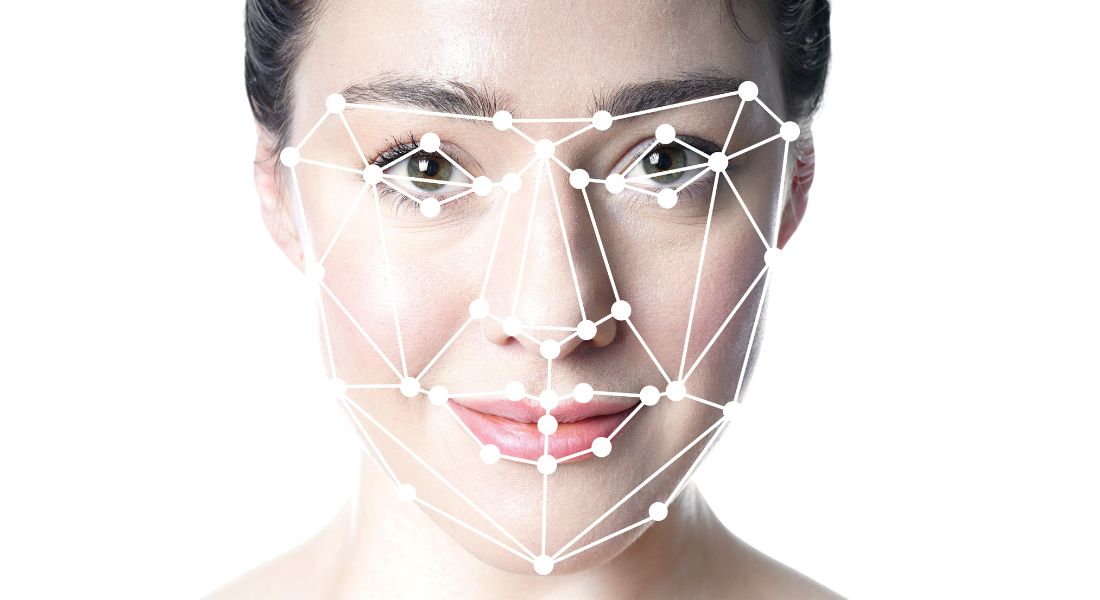
Artificial intelligence has entered dermatology faster than most patients realise. Skin analysis apps, automated mole checks, and image-based risk scores are now widely available, often marketed as fast, objective, and reassuring.
At the same time, many people feel confused. Some wonder whether AI can replace clinical appointments. Others worry about missed diagnoses or false reassurance. The truth sits somewhere between enthusiasm and caution.
In this article, I’ll explain where AI genuinely adds value in dermatology, where it is currently overhyped, and why specialist assessment by a trained Dermatologist remains essential despite rapid technological progress.
Why AI Took Hold in Dermatology So Quickly
Dermatology relies heavily on visual assessment. Many skin conditions are identified through patterns, colour changes, symmetry, and surface structure, making the specialty particularly suited to image-based technologies. This visual nature explains why artificial intelligence gained traction in dermatology so rapidly.
Here’s why AI became attractive in this field:
1. Dermatology Is Highly Visual – Skin conditions are often recognised by how they look rather than by laboratory values alone. Pattern recognition plays a central role in everyday dermatological practice.
2. Large Image Datasets Enable AI Training – Dermatology has access to extensive image libraries across many conditions and skin types. These datasets allow algorithms to learn visual similarities and classify images at scale.
3. AI Excels at Pattern Matching – Image-based AI systems are designed to detect patterns, symmetry, and colour differences. This makes them effective at identifying visual features that resemble known conditions.
4. Visual Similarity Is Not Clinical Understanding – While AI can recognise patterns, it does not understand symptoms, context, or disease behaviour. Clinical judgement requires integrating visual findings with history, examination, and risk assessment.
AI can be a useful support tool, but it cannot replace clinical expertise. Visual resemblance alone does not account for variation, evolution over time, or underlying systemic disease. Understanding these limitations is essential when using AI alongside dermatological assessment.
What AI in Dermatology Actually Refers To
AI in dermatology usually refers to machine-learning systems that analyse images of the skin. We understand these tools are trained on large datasets of labelled photographs to recognise visual patterns. Their role is to support assessment by identifying similarities, not to provide a definitive diagnosis.
These systems work by comparing an uploaded image with thousands or even millions of examples. We interpret the output as an estimate of how closely a skin feature matches known conditions. The result is a probability or risk signal rather than a medical conclusion.
Most consumer-facing tools focus on specific tasks such as lesion risk, acne severity, or general skin analysis. We use this information cautiously and in context. Clinical judgement remains essential, with AI acting as a supportive aid rather than a replacement for expert evaluation.
Where AI Genuinely Helps Dermatologists
AI is most effective when used as a supportive tool alongside clinical expertise. It does not replace judgement, but it can assist with specific tasks that enhance accuracy and efficiency. When applied appropriately, AI helps dermatologists focus their attention where it matters most.
AI supports dermatology practice by:
- Assisting with image comparison – AI can compare current and previous images to highlight subtle changes that may be difficult to detect visually.
- Supporting change detection over time – Tracking progression or regression helps identify evolving conditions earlier and more reliably.
- Flagging concerning patterns – Certain visual features or combinations can be highlighted for closer clinical review.
- Helping prioritise urgent cases – AI can assist in triaging cases that may need faster assessment or referral.
Used correctly, AI reduces cognitive load and supports decision-making, while clinical reasoning and responsibility remain firmly with the dermatologist.
AI and Mole Monitoring: A Real Advantage

Monitoring moles over time is one area where artificial intelligence offers genuine clinical value. Subtle changes can be difficult to detect by memory or visual comparison alone, especially when assessments are spread over months or years.
Here’s where AI adds value in mole monitoring:
1. Longitudinal Image Comparison – AI systems can store and compare high-quality images taken at different time points. This allows precise tracking of changes that may otherwise go unnoticed.
2. Detection of Subtle Visual Changes – Small variations in size, shape, or colour can be difficult for the human eye to assess consistently. AI can highlight these changes objectively and prompt closer review.
3. Consistency Over Time – Digital systems apply the same comparison criteria each time images are reviewed. This consistency reduces the risk of variation between assessments.
4. Supports Earlier Clinical Review – When changes are flagged, patients can be reviewed sooner by a clinician. This supports timely assessment without relying on automated diagnosis.
AI acts as an aid rather than a decision-maker. It supports clinicians by improving surveillance and consistency, while final judgement remains firmly clinical. Used appropriately, this approach strengthens safety without replacing expert assessment.
Why Change Detection Matters More Than Labels
Skin cancer assessment often depends on how a lesion changes over time, not just how it looks at a single moment. We place strong emphasis on evolution in size, colour, or structure, as these shifts can be more informative than appearance alone. Monitoring over time helps us detect patterns that static images cannot show.
AI is particularly effective at pixel-level comparison across sequential images. We use this capability to support monitoring in patients with multiple moles, where subtle changes may be difficult to track manually. This technology helps highlight areas that deserve closer attention.
However, identifying change is only one part of clinical decision-making. We interpret these findings alongside examination, history, and risk factors. Change prompts evaluation, but clinical significance is determined through expert assessment, not algorithms alone.
AI in Triage and Workflow Efficiency
Dermatology services often manage large numbers of images and referrals. In this setting, artificial intelligence can support clinicians by improving organisation and prioritisation, rather than by making diagnoses.
Here’s how AI supports triage and efficiency:
1. Sorting High Volumes of Images – AI systems can rapidly review large image datasets and group cases by urgency. This helps services manage demand more effectively.
2. Flagging Lesions Needing Prompt Review – Images showing features associated with higher risk can be highlighted for earlier assessment. This supports faster clinical review where it matters most.
3. De-Prioritising Clearly Benign Appearances – Cases that appear low risk can be safely placed lower in the queue for review. This allows clinical time to be focused on more concerning cases.
4. Triage Support Is Not Diagnosis – AI assists with prioritisation but does not replace clinical judgement. Decisions about diagnosis and treatment remain the responsibility of a trained clinician.
Used appropriately, AI improves workflow without compromising safety. By supporting triage rather than making autonomous decisions, it helps dermatology services deliver timely care while maintaining clinical oversight.
AI and Acne Severity Tracking
AI can be helpful in bringing consistency to how acne is assessed over time. Rather than relying solely on visual estimation, objective scoring allows clearer comparison between visits. This supports more structured monitoring during treatment.
AI contributes to acne management by:
- Objectively scoring severity – Automated assessment can quantify acne intensity and distribution in a consistent way.
- Tracking response to treatment – Changes over time are easier to compare, helping identify improvement or lack of response.
- Reducing subjective variation – Consistent scoring limits differences between assessors or clinic visits.
- Supporting, not replacing, clinical judgement – While severity tracking is useful, treatment decisions still depend on symptoms, scarring risk, and patient context.
Although AI adds value in monitoring, acne diagnosis itself is usually straightforward, and management remains guided by clinical expertise.
Where AI Falls Short Clinically
AI systems can only analyse what they have been trained to recognise visually. We recognise that these tools do not understand symptoms, duration, triggers, medications, or wider health conditions that often shape a diagnosis. Skin disease is rarely just an image problem.
AI also struggles with atypical or evolving presentations. We see many cases where inflammation, infection, or treatment effects alter appearance in ways algorithms cannot reliably interpret. These nuances require clinical context and experience.
This limitation is critical and frequently overlooked in marketing claims. We approach AI with realism rather than reliance. By understanding where it falls short, we ensure technology supports care without creating false reassurance or misplaced confidence.
Why Context Matters in Dermatology
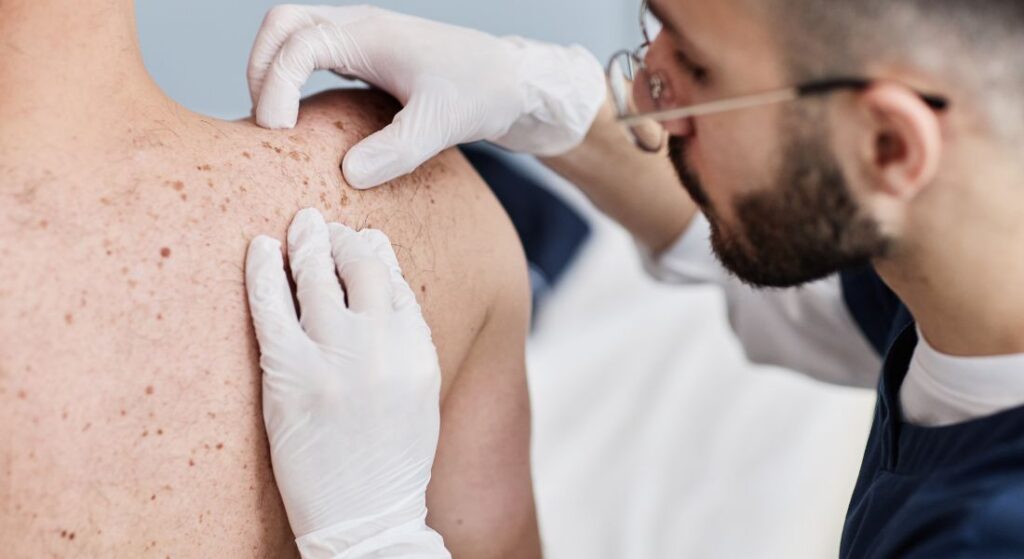
Two rashes can look very similar on the surface yet behave in completely different ways. We consider how symptoms evolve, not just how the skin appears at a single point in time. Visual similarity alone is rarely enough to guide safe diagnosis.
Factors such as pain, itch, systemic symptoms, immune status, and timing can fundamentally change what a rash represents. We rely on this broader context to understand whether a condition is inflammatory, infectious, autoimmune, or reactive. These details cannot be assessed by AI from an image alone.
Clinical history is not optional in dermatology. We integrate patient history with examination findings to build an accurate picture. Without context, even advanced tools risk misinterpretation and oversimplification.
The Problem of Atypical Presentations
Medical textbooks tend to show clear, fully developed examples of disease. In real clinical practice, however, patients often present in ways that do not match these idealised images. This gap creates challenges for both technology and diagnosis.
Here’s why atypical presentations matter:
1. Textbook Images Show Classic Patterns – Teaching images usually represent well-established, typical disease features. These examples are helpful for learning but do not reflect the full range of real-world presentations.
2. Real Patients Rarely Follow Textbook Rules – Patients may present early, late, partially treated, or with symptoms that overlap multiple conditions. These variations make visual recognition more complex.
3. Atypical Cases Challenge AI Systems – AI systems are often trained on idealised datasets with clear labels. When faced with mixed or evolving features, performance can be less reliable.
4. Clinical Training Focuses on Grey Areas – Dermatologists are trained to manage uncertainty and atypical presentations. Experience allows them to integrate history, examination, and evolution over time.
Atypical presentations are common rather than exceptional. Managing them safely requires clinical judgement, follow-up, and flexibility skills that go beyond image recognition alone. This is where human expertise remains essential.
Skin Tone Bias in AI Systems
AI systems are only as reliable as the data they are trained on. When datasets do not reflect the full range of skin tones, performance can vary significantly between individuals. This limitation has important implications for accuracy and safety in dermatology.
Skin tone bias affects AI systems because:
- Darker skin tones are under-represented in training data – Limited diversity reduces the system’s ability to recognise conditions accurately across all skin types.
- Clinical signs appear differently across skin tones – Redness, inflammation, and pigment changes may be subtler or present differently with higher melanin levels.
- Reduced diagnostic accuracy increases risk – Missed or delayed recognition can lead to inappropriate reassurance or delayed treatment.
- Bias in data becomes bias in care – Training limitations translate directly into unequal clinical performance and potential harm.
Addressing skin tone bias is essential before AI tools can be safely and equitably used in routine dermatology practice.
Why False Reassurance Is Dangerous
Some apps label skin lesions as “low risk” or “likely benign,” which can create a false sense of security. We see how this reassurance may delay medical review, even when symptoms continue to change or worsen. Early confidence can discourage timely assessment.
False reassurance is often more harmful than honest uncertainty. We recognise that reassurance without full context may prevent important follow-up or investigation. Uncertainty, when managed properly, keeps the door open to reassessment and safety.
Dermatologists treat uncertainty as a signal for review rather than dismissal. We encourage monitoring, follow-up, and professional evaluation when doubt exists. This approach prioritises patient safety over premature conclusions.
The Limits of AI in Risk Assessment and Examination
False positives have consequences as well as missed diagnoses. We see how over-calling risk can increase anxiety, drive unnecessary appointments, and sometimes lead to unwarranted procedures. Balancing risk requires clinical judgement, not algorithmic thresholds alone.
Many skin conditions still require physical examination. We rely on palpation, texture assessment, and full-body review to understand depth, tenderness, and distribution. Cropped images cannot capture surrounding skin or related signs, and dermatology involves far more than image classification.
Why AI Doesn’t Understand Disease Evolution
AI analyses individual snapshots of the skin taken at a single moment in time. We understand that these isolated images cannot show how a condition has developed or where it may be heading.
Dermatologists assess trajectories rather than static appearances. We observe how conditions evolve, respond to treatment, or relapse over time. This ongoing assessment provides insights that a single image cannot capture.
This temporal understanding is essential in inflammatory, autoimmune, and scarring conditions. We rely on follow-up and pattern progression to guide safe and effective care.
AI and Diagnostic Confidence

Artificial intelligence can provide useful information, but it does not make clinical decisions. Its outputs require interpretation within a broader medical context to be meaningful and safe.
Here’s why AI alone cannot provide diagnostic confidence:
1. AI Produces Probabilities, Not Decisions – AI systems generate likelihood scores based on patterns they recognise. These figures indicate probability, not a confirmed diagnosis.
2. Percentages Are Not Clinically Actionable on Their Own – A result such as a “70% likelihood” does not define treatment or next steps. Clinical judgement is needed to determine whether investigation, monitoring, or reassurance is appropriate.
3. Probabilities Are Easily Misinterpreted by Patients – Patients may view probability scores as definitive conclusions. Without explanation, this can cause unnecessary anxiety or false reassurance.
4. Clinical Interpretation Remains Essential – Experienced clinicians translate AI outputs into practical decisions. This includes explaining uncertainty, weighing risk, and planning appropriate follow-up.
AI can support decision-making, but it cannot replace expert explanation. Confidence in diagnosis comes from combining technology with clinical experience, communication, and context. This ensures patients receive clear, balanced, and safe guidance.
Why AI Is Often Overhyped in Consumer Apps
Marketing around consumer AI tools often implies certainty, speed, and independence from clinicians. We recognise that regulatory standards for these apps are far lower than for medical diagnostics, and many are not validated for clinical decision-making. This gap between promise and reality can create confusion and misplaced confidence.
AI technology also evolves faster than regulation and evidence can keep pace. We see frequent updates that make long-term validation and consistent performance difficult to ensure. Dermatology depends on proven safety, accountability, and reliability, not rapid innovation alone.
The Practical Role of AI in Modern Dermatology
AI plays a valuable role in dermatology research and education. We use it to analyse large datasets, identify trends, and generate research hypotheses that would be difficult to detect manually. It also supports training by exposing clinicians to a wide range of skin images and presentations.
In clinical practice, the most realistic role for AI is as a second pair of eyes. We use it to support vigilance, improve consistency, and assist with monitoring over time. However, responsibility for interpretation and decision-making always remains with the clinician.
Dermatology is not just pattern recognition, but pattern recognition guided by judgement. We rely on experience to recognise when findings do not fit expected patterns or when something feels clinically inconsistent. This is where specialist assessment remains essential, as AI struggles most in the grey areas where expertise matters most.
Using AI Safely and Effectively in Dermatology
The future of dermatology is collaborative, not competitive. We use AI to support data processing, comparison, and monitoring, while clinical judgement, history-taking, and management decisions remain our responsibility. This partnership improves both safety and efficiency when used appropriately.
AI tools can be helpful for awareness and self-monitoring, encouraging earlier review or tracking change over time. However, we are clear that AI should never be used alone for rapidly changing, painful, or complex skin conditions. In these situations, context and examination are essential, and AI is not designed to manage diagnostic complexity.
Human oversight in medicine is non-negotiable. We remain accountable for decisions, ethical standards, and patient outcomes, including how data is handled and interpreted. By choosing specialist care, patients ensure technology is applied thoughtfully, responsibly, and in a way that protects long-term skin health.
FAQs:
1. Can AI accurately diagnose skin conditions on its own?
AI cannot accurately diagnose skin conditions on its own in a clinically safe way. While it can recognise visual similarities and patterns in images, it does not understand symptoms, medical history, medications, or how a condition behaves over time. Diagnosis in dermatology requires context, evolution, and clinical judgement, all of which sit outside the capability of current AI systems. AI can support assessment, but it cannot replace a trained clinician.
2. Are skin analysis apps reliable for checking moles or rashes?
Skin analysis apps can be useful for raising awareness or encouraging people to seek medical advice, but they are not reliable diagnostic tools. These apps often provide probability-based outputs that can be misinterpreted as definitive answers. They may miss concerning changes or falsely reassure users, which can delay professional assessment. Any persistent, changing, or symptomatic skin lesion should always be reviewed by a dermatologist, regardless of app results.
3. Why do dermatologists still need to examine the skin in person if AI exists?
In-person examination allows dermatologists to assess texture, depth, tenderness, distribution, and surrounding skin, none of which can be reliably evaluated through images alone. A full assessment also includes reviewing the entire skin surface, not just one lesion, and integrating symptoms, timing, and medical history. AI cannot replicate this comprehensive evaluation, which is essential for safe and accurate diagnosis.
4. Can AI miss serious skin conditions like melanoma?
Yes, AI can miss serious conditions, particularly when presentations are atypical, evolving, or affected by prior treatment. AI systems are trained on existing image datasets and may not perform well when a lesion does not closely match those examples. This risk is particularly concerning when apps provide reassurance without clinical oversight, potentially delaying urgent medical review.
5. Why does AI sometimes give conflicting or confusing results?
AI systems generate probability scores based on visual similarity rather than clinical certainty. Different lighting, angles, image quality, or minor changes in appearance can significantly alter outputs. Without clinical interpretation, these results can seem inconsistent or alarming. Dermatologists understand how to interpret uncertainty and variability, whereas AI presents data without meaningful clinical context.
6. Does AI work equally well on all skin tones?
At present, many AI systems perform less reliably across diverse skin tones due to under-representation in training datasets. In darker skin tones, inflammation, redness, and pigment changes may appear differently, reducing algorithm accuracy. This bias can lead to missed or delayed recognition of conditions, making clinical expertise essential for fair and safe assessment.
7. Can AI help monitor skin conditions over time?
Yes, AI can be helpful in monitoring change over time, particularly for mole surveillance or acne severity tracking. By comparing images taken at different time points, AI can highlight subtle changes that might otherwise be missed. However, identifying change is only the starting point. Determining whether that change is clinically significant still requires expert interpretation.
8. Why do dermatologists focus more on change than AI-generated labels?
In dermatology, how a condition evolves is often more important than how it looks at a single moment. AI labels are based on static image comparison, whereas dermatologists assess progression, response to treatment, and symptom development over time. Change provides insight into disease behaviour, risk, and urgency, which cannot be captured by a single AI-generated output.
9. Is AI useful at all if it cannot make diagnoses?
AI is useful when applied appropriately and with clear limitations. It can support consistency, assist with monitoring, improve triage efficiency, and act as a second pair of eyes. Its value lies in augmentation rather than replacement of clinical judgement. When used responsibly within a specialist setting, AI can enhance care without compromising safety.
10. Should patients trust AI tools over seeing a dermatologist?
AI tools should never replace professional medical assessment. While they may encourage awareness or earlier consultation, they cannot provide the reassurance, explanation, and accountability that specialist care offers. Dermatology involves managing uncertainty, recognising atypical patterns, and making nuanced decisions based on experience. Trusting expert clinical judgement remains essential for safe diagnosis and effective care.
Final Thoughts: Technology Supports Care, Expertise Guides It
AI has a genuine place in modern dermatology, particularly in monitoring change, improving consistency, and supporting workflow. However, it does not understand symptoms, context, or disease behaviour over time. I see AI as a supportive tool rather than a decision-maker. Used wisely, it can enhance care, but relying on it alone risks false reassurance, missed diagnoses, and unnecessary anxiety.
If you’re unsure about skin concern or results from an app, seeing a Dermatologist at a specialist clinic in London remains essential. You can book a consultation with one of our dermatologists by contacting us at the London Dermatology Centre.
References:
1. Hornung, A., Steeb, T., Wessely, A., Brinker, T.J., Breakell, T., Erdmann, M., Berking, C. and Heppt, M.V., 2021. https://www.mdpi.com/1660-4601/18/4/1726
2. Liu, Y., et al. (2020). A deep learning system for differential diagnosis of skin diseases. Nature Medicine, 26(6), 900–908. https://pubmed.ncbi.nlm.nih.gov/32424212/
3. Guida, S., Longhitano, S., Ardigò, M., Pampena, R. et al. (2021). Dermoscopy, confocal microscopy and optical coherence tomography features of main inflammatory and autoimmune skin diseases: A systematic review. Australasian Journal of Dermatology, 63(1), 15–26. https://pubmed.ncbi.nlm.nih.gov/34423852/
4. Basics and principles of reflectance confocal microscopy. Journal of the American Academy of Dermatology. https://www.sciencedirect.com/science/article/abs/pii/S0190962215016199
5. Tatu, A. L. & Nwabudike, L. C. (2025). Special Issue “Diagnosis and Management of Skin Diseases, Related Disorders and Their Comorbidities.” Diagnostics, 15(7), 897. https://www.mdpi.com/2075-4418/15/7/897