


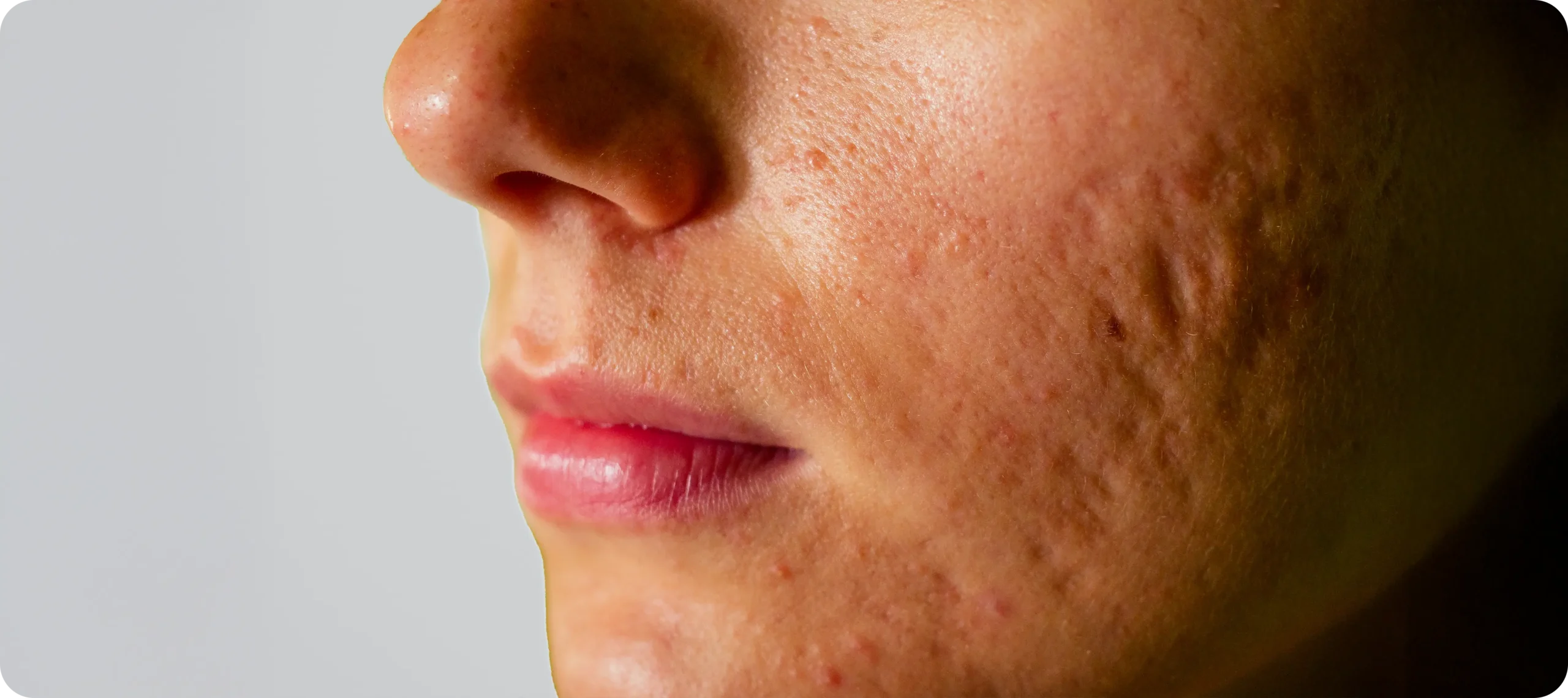
If you’ve been living with acne scars for years, you might already know how confusing it can be to understand your scar type. Many people assume all acne scars are the same, or they’re treated with generic procedures that sound promising but leave them disappointed. One of the biggest reasons for poor results is simple: the wrong scar type was treated with the wrong method.
Rolling scars and boxcar scars may look similar when you glance in the mirror, but they behave differently, form differently, and most importantly respond to different treatments. When these scars are misidentified, you can spend months and money on treatments that barely make a difference. When they’re correctly recognised, however, the right approach can finally create the improvements you’ve been trying to achieve for years.
Why Understanding Your Acne Scar Type Matters More Than You Think
Many people assume acne scars are just a surface-level problem that can be fixed with a single treatment. In reality, acne scars often extend deep into the skin. Each scar type has a unique structure, depth, and cause, so treating only the surface won’t fully correct the issue.
Using the wrong treatment can lead to minimal improvement, uneven results, worsened texture, or the need for additional corrective sessions. This is why accurate identification of your scar type is so important.
Different scars require different approaches: some need fibrotic bands broken, some need lost collagen replaced, others require resurfacing, volume restoration, or treatment of skin laxity. Rolling scars and boxcar scars may look similar at first glance, but they often need completely different strategies.
What Causes Rolling and Boxcar Scars? Understanding the Foundations
To understand why proper diagnosis matters, it helps to understand how these scars form. Rolling scars develop when fibrous bands form beneath the skin’s surface, anchoring the skin downward. These bands tether the skin in a wave-like pattern, creating wide depressions with soft edges. The skin looks like it’s gently dipping down, often changing appearance under different lighting.
Boxcar scars form through lost collagen that creates sharply defined edges. Instead of sloping depressions, they appear punched out, with clear boundaries that drop into the skin like a small crater. They can be shallow or deep but are typically round or oval with vertical walls. These structural differences are critical because they determine how dermatologists approach your treatment plan.
Rolling Acne Scars: How to Identify Them on Your Own
Rolling scars are typically soft, wavy indentations in the skin that give the appearance of being gently pulled downward from beneath. You might notice that the depressions connect or shift slightly when you stretch or manipulate the skin.
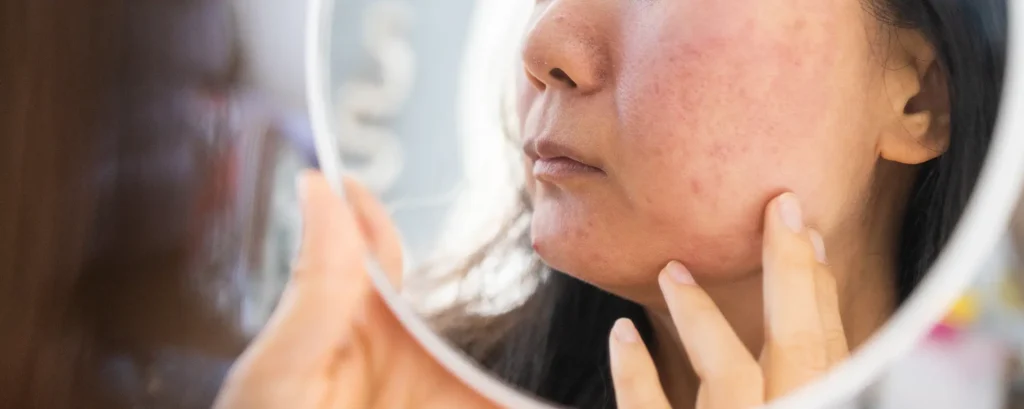
These scars often become more noticeable under side lighting. Tilting your face near a window or using a lamp can create shadows that highlight the skin’s uneven texture, making the depressions easier to see.
Key features of rolling scars include:
- Wide in diameter: They cover larger areas compared with other acne scars.
- Soft-edged: The borders are gentle and rounded rather than sharply defined.
- Shallow to moderate in depth: They create noticeable unevenness but are not as deep as icepick or boxcar scars.
- Caused by fibrous anchoring bands beneath the skin: These bands pull the surface downward, creating the characteristic rolling appearance.
If your skin appears bumpy or uneven when smiling, pressing your cheek, or under angled light, it is likely that you are dealing with rolling scars. Recognising these features is an important first step toward choosing the most suitable treatment.
Boxcar Acne Scars: How They Look and Why They’re Different
Boxcar scars are generally easier to identify than rolling scars because of their distinct, well-defined shape. They have sharp edges with a noticeable drop into the depression. Unlike rolling scars, which slope gently, boxcar scars appear more like small, punched-out holes in the skin.
Boxcar scars can vary in depth:
- Shallow – Often respond well to skin resurfacing treatments, making them easier to improve with non-invasive procedures.
- Moderate – May require targeted interventions such as chemical peels or microneedling, which stimulate collagen and smooth the skin.
- Deep – Typically need structural treatments or collagen-stimulating procedures, as the skin loss is more pronounced and requires rebuilding from beneath.
These scars form due to significant collagen loss during inflammation. The lack of supporting tissue beneath the scar results in the distinct, sharp edges, which make boxcar scars clearly different from rolling or icepick scars.
Understanding Your Acne Scars: Why Accurate Diagnosis Matters
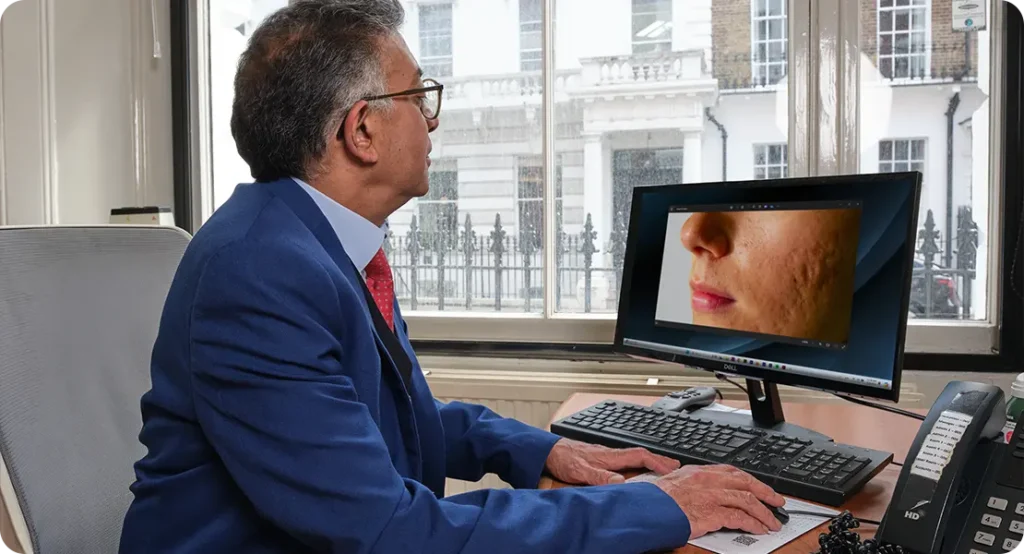
Before choosing a treatment, it’s important to know exactly what type of acne scars you have. Not all scars respond the same way to treatments, and what works for one type may be ineffective for another. A trained dermatologist uses specific techniques to examine your skin closely, ensuring that the treatment plan is tailored to your unique scar pattern and structure.
- Direct clinical examination – The dermatologist visually inspects your skin to observe the shape, edges, and overall pattern of scars.
- Side-lighting evaluation – Shining light at an angle across the skin helps reveal depth and shadowing, highlighting differences between rolling, boxcar, and icepick scars.
- Skin stretching – Pulling the skin taut can show how scars respond, rolling scars often soften or flatten, whereas boxcar scars remain sharply defined.
- Palpation (feeling the skin) – Touching the scar allows the clinician to assess firmness, texture, and underlying fibrous bands.
- Scar depth measurement – Measuring the depth of each scar helps determine the appropriate treatment approach.
- Assessment under magnification – Using magnifying tools ensures even subtle or shallow scars are accurately identified.
Lighting is one of the most important tools. Rolling scars cast soft, diffuse shadows, while boxcar scars create sharper, well-defined shadows, making identification easier.
Why Misdiagnosis Leads to Poor Acne Scar Results
One of the most frustrating experiences for patients is undergoing multiple acne scar treatments and seeing minimal improvement. This usually happens when the scar subtype is misdiagnosed or poorly understood.
For example, rolling scars require subcision, a technique that cuts the fibrotic bands beneath the skin, before any resurfacing can be effective. Without subcision, resurfacing lasers cannot lift the tethered skin, leaving the scar unchanged.
Boxcar scars, on the other hand, benefit from edge softening and collagen induction. Using subcision unnecessarily on these scars can actually reduce effectiveness and create uneven results.
Rolling Scars: Why Subcision Is Essential

Rolling scars require a very specific approach, and subcision is the most important part of their treatment. This technique uses a fine needle or cannula to carefully release the fibrous bands that pull the skin downward. Once these bands are cut, the skin is free to lift, reducing the anchored, uneven look that makes rolling scars so noticeable.
Without subcision, rolling scars tend to stay flat and tethered no matter what other treatments are used. Lasers cannot reach deep enough to break the fibrous bands, microneedling on its own cannot release the underlying pull, and volume replacement may add fullness but does not correct the root cause of the scar.
Boxcar Scars: Why Edge Treatment Matters
Because boxcar scars have sharp edges, the focus is on softening those edges and filling the depth. Techniques for boxcar scars require remodelling collagen and smoothing the transition between normal skin and the recessed scar.
This often includes:
- Laser resurfacing: Helps smooth sharp scar edges and stimulate new collagen to blend the depression into surrounding skin.
- Microneedling with radiofrequency (RF): Delivers controlled heat into the dermis, encouraging collagen tightening and gradual softening of scar borders.
- Chemical peels for shallow scars: Improve surface texture and tone, making mild boxcar scars less noticeable over time.
- TCA CROSS for deeper scars: Targets the base of deep boxcar scars to rebuild collagen from within and reduce depth.
- Dermal fillers (in certain cases): Temporarily lift the scar base when volume loss contributes to the depression.
Boxcar scars do not respond as dramatically to subcision unless tethering bands are present, which is less common in true boxcar scars. Treatment must be planned carefully, as overly aggressive approaches can widen scar edges or make the depression more noticeable rather than improving it.
Understanding Depth: Shallow vs Deep Boxcar Scars
Shallow boxcar scars often respond extremely well to resurfacing treatments such as fractional lasers, microneedling, or chemical peels. Because their depth is mild, improving the surface texture can significantly reduce how noticeable they appear.
Deep boxcar scars require a more customised, layered approach because surface treatments alone cannot reach the base of the scar.
This often includes:
- TCA CROSS: Applied directly into the scar to stimulate collagen formation from the base upward, helping reduce depth.
- Laser resurfacing: Smooths sharp edges and improves skin texture while supporting collagen remodelling around the scar.
- Collagen stimulation treatments: Encourages gradual thickening of the dermis to support the scar structure over time.
- Occasional subcision (if tethering is present): Used selectively when fibrous bands are pulling the scar downward, although this is less common in true boxcar scars.
The deeper the scar, the more structural and carefully staged the treatment needs to be to achieve meaningful improvement without worsening the scar edges.
Stretch Test: A Simple Tool Dermatologists Use
The stretch test is a simple but highly effective method dermatologists use to identify acne scar types. During this test, the dermatologist gently stretches the skin around a scar and observes how it responds.
If the scar softens or becomes less visible when the skin is stretched, it usually indicates a rolling scar. If the scar’s edges remain firm, sharp, and well defined despite stretching, it is more likely to be a boxcar scar.
This straightforward manoeuvre reveals what is happening beneath the surface of the skin. By understanding the scar’s underlying structure, the clinician can accurately diagnose the scar type and select the most effective treatment approach.
Why You Might Have Both Scar Types
Most people don’t have just one scar type. Rolling scars and boxcar scars frequently appear together, along with other types like ice-pick scars or atrophic scars. Acne is a complex inflammatory disease, and each breakout can affect the skin differently.
Your dermatologist will assess each region of your face separately because different areas may require different techniques. This is another reason why clinics specialising in acne scar treatment in London emphasise individualised plans rather than generic packages.
Why Rolling and Boxcar Scars Respond Differently to the Same Treatment
Rolling and boxcar scars behave very differently beneath the skin, which is why they respond in completely different ways to the same treatment. A procedure that delivers excellent results for one scar type can be surprisingly ineffective for another.
Laser resurfacing, for example, works well for boxcar scars because it helps soften sharp edges and stimulates collagen in a relatively uniform depression. However, rolling scars are held down by fibrous bands beneath the surface, so resurfacing alone cannot lift them, no matter how advanced the laser is.
Subcision, on the other hand, is highly effective for rolling scars because it releases this tethering. But boxcar scars are not usually anchored by fibrous bands, so subcision on its own tends to make only a limited difference.
How Dermatologists Create a Treatment Plan Based on Scar Type
Dermatologists don’t choose acne scar treatments at random. A personalised treatment plan is created only after carefully analysing the type and depth of your scars and how your skin is likely to respond.
A plan may include a combination of treatments such as subcision, laser resurfacing, microneedling, radiofrequency, TCA CROSS, skin boosters, fillers, PRP, or collagen-stimulating injectables. Each option has a specific role, and not every treatment is suitable for every scar.
The final plan is shaped by several factors, including how deep your scars are, the exact scar subtype, your skin type, your expectations, your ability to heal, and how much downtime you can realistically tolerate. For example, rolling scars usually require subcision as the starting point to release tethering, while boxcar scars are more effectively treated with resurfacing techniques that soften edges and stimulate collagen.
Why the Wrong Treatment Can Make Boxcar Scars Look Worse
Boxcar scars can sometimes look worse when the wrong treatment approach is used. If resurfacing is done without first softening the sharp edges of the scar, those edges can spread outward, making the scar appear wider. When a strong laser is applied incorrectly, it can also create uneven texture or a raised “plateau” around the scar instead of blending it smoothly with the surrounding skin.
This happens because boxcar scars are structured scars. They require controlled, gradual remodelling of the skin rather than aggressive tissue removal. When the technique is properly planned and carefully executed, the scar lifts and blends over time instead of changing abruptly in a way that draws more attention to it.
Can Rolling Scars Be Mistaken for Boxcar Scars? Yes Often
These two scar types are commonly confused. Rolling scars can resemble shallow boxcar scars at first glance, while boxcar scars may appear softer in certain lighting and sharper in others.
Misidentification is one of the most common reasons people feel disappointed with their scar treatment results.
A trained dermatologist examines:
- Scar diameter: Rolling scars tend to be wider and more diffuse, while boxcar scars usually have a more defined width.
- Scar edge sharpness: Soft, sloping edges suggest rolling scars, whereas crisp, vertical edges point to boxcar scars.
- Scar depth: Depth helps determine whether surface treatments will be effective or if deeper intervention is required.
- Scar behaviour with movement: Rolling scars often change when smiling or stretching the skin; boxcar scars usually remain fixed.
- Skin thickness: Thinner skin can make scars appear deeper and influences which treatments are safe.
- Lighting effect: Side lighting reveals the true structure of scars by casting shadows that highlight their shape.
- Stretch response: Rolling scars may flatten when the skin is pulled taut, while boxcar scars stay visible due to rigid edges.
Only a comprehensive, hands-on examination reveals the true scar type and allows for an effective, personalised treatment plan.
How to Know If Your Previous Treatment Failed Due to Misdiagnosis
If your previous acne scar treatments did not deliver the results you were expecting, misdiagnosis may be the reason. When the underlying scar type is not correctly identified, even advanced treatments can fail to produce visible improvement.
Signs of possible misdiagnosis include scars that did not lift despite multiple laser sessions, rolling scars that still appear tethered, or boxcar scars that look wider after treatment. You may also notice an uneven, plate-like skin texture or realise that only one type of treatment was used despite having multiple scar types. In many cases, getting the diagnosis right is the turning point for patients who have struggled with ineffective treatments for years.
FAQs:
1. What is the main difference between rolling and boxcar acne scars?
Rolling scars are caused by fibrous bands beneath the skin that pull the surface downward, creating soft, wave-like depressions. Boxcar scars, on the other hand, form due to collagen loss and have sharply defined edges with a noticeable drop into the skin, giving them a punched-out appearance.
2. Can rolling and boxcar scars look similar at first glance?
Yes, rolling and shallow boxcar scars can appear similar under certain lighting conditions, which is why they are often misidentified. However, their behaviour under skin stretching and angled light usually reveals important structural differences.
3. Why is correct scar identification so important before treatment?
Correct identification ensures that the treatment targets the actual cause of the scar rather than just the surface. Using the wrong approach can lead to poor improvement, uneven texture, or scars appearing wider or more noticeable after treatment.
4. How do dermatologists tell rolling scars apart from boxcar scars?
Dermatologists use a combination of visual examination, side lighting, skin stretching, palpation, and magnification to assess scar edges, depth, and movement. These methods reveal whether the scar is tethered by fibrous bands or shaped by collagen loss.
5. Why don’t lasers alone work well for rolling scars?
Lasers treat the skin surface and stimulate collagen but cannot cut the fibrous bands that anchor rolling scars. Without releasing these bands through subcision, the skin remains tethered and cannot lift, limiting visible improvement.
6. Is subcision useful for boxcar scars?
Subcision is generally not the primary treatment for boxcar scars because they are not usually held down by fibrous bands. In some cases where tethering exists, it may be used selectively, but most boxcar scars respond better to edge softening and collagen remodelling.
7. Do shallow and deep boxcar scars require different treatments?
Yes, shallow boxcar scars often respond well to resurfacing treatments that smooth the skin texture. Deep boxcar scars usually need more structural treatments, such as TCA CROSS and collagen stimulation, because surface treatments alone cannot reach the base of the scar.
8. Can one person have both rolling and boxcar scars?
Most people have a combination of scar types rather than just one. Different acne lesions heal in different ways, which is why dermatologists assess each area of the face separately and tailor treatments accordingly.
9. How can the wrong treatment make boxcar scars look worse?
Aggressive or poorly planned resurfacing can cause boxcar scar edges to spread, making them appear wider. Incorrect technique may also create uneven texture or a raised rim around the scar instead of blending it smoothly into surrounding skin.
10. How can I tell if my previous acne scar treatment failed due to misdiagnosis?
If your scars did not improve after multiple sessions, rolling scars still look tethered, boxcar scars appear wider, or only one treatment was used despite having multiple scar types, misdiagnosis may be the reason. In many cases, reassessment and correct identification lead to significantly better outcomes.
Final Thought: Why Correct Scar Identification Matters
Rolling and boxcar acne scars may look similar on the surface, but beneath the skin they behave very differently. When these differences are not properly identified, even advanced treatments can fail to deliver meaningful improvement. Correct diagnosis is what determines whether scars lift, soften, and blend over time or remain unchanged despite repeated procedures.
A thorough, hands-on assessment by an experienced dermatologist is the most important step in achieving real results. By understanding scar structure, depth, and behaviour, treatment can be tailored to address the true cause of the scarring rather than just the visible texture. If you’re considering acne scar treatment in London, you can contact us at London Dermatology Centre to book a consultation with one of our specialists.
References:
1. Kravvas, G. and Liew, S. (2018) A systematic review of treatments for acne scarring. Part 1, Journal of Cosmetic Dermatology, 17(1), pp. 33–41. https://pubmed.ncbi.nlm.nih.gov/29799567/
2. Boen, M. et al. (2019) A review and update of treatment options using the acne scar classification system, International Journal of Dermatology, 58(11), pp. 1272–1279. https://pubmed.ncbi.nlm.nih.gov/30856634/
3. Connolly, D. et al. (2017) Acne Scarring — Pathogenesis, Evaluation, and Treatment Options, Journal of Clinical and Aesthetic Dermatology. https://pmc.ncbi.nlm.nih.gov/articles/PMC5749614/
4. Vempati, A. et al. (2023) Subcision for Atrophic Acne Scarring: A Comprehensive Review. https://pmc.ncbi.nlm.nih.gov/articles/PMC9868281/
5. Chilicka, K., Rusztowicz, M., Szyguła, R. and Nowicka, D. (2022) Methods for the Improvement of Acne Scars Used in Dermatology and Cosmetology: A Review, Journal of Clinical Medicine, 11(10), 2744. https://www.mdpi.com/2077-0383/11/10/2744