


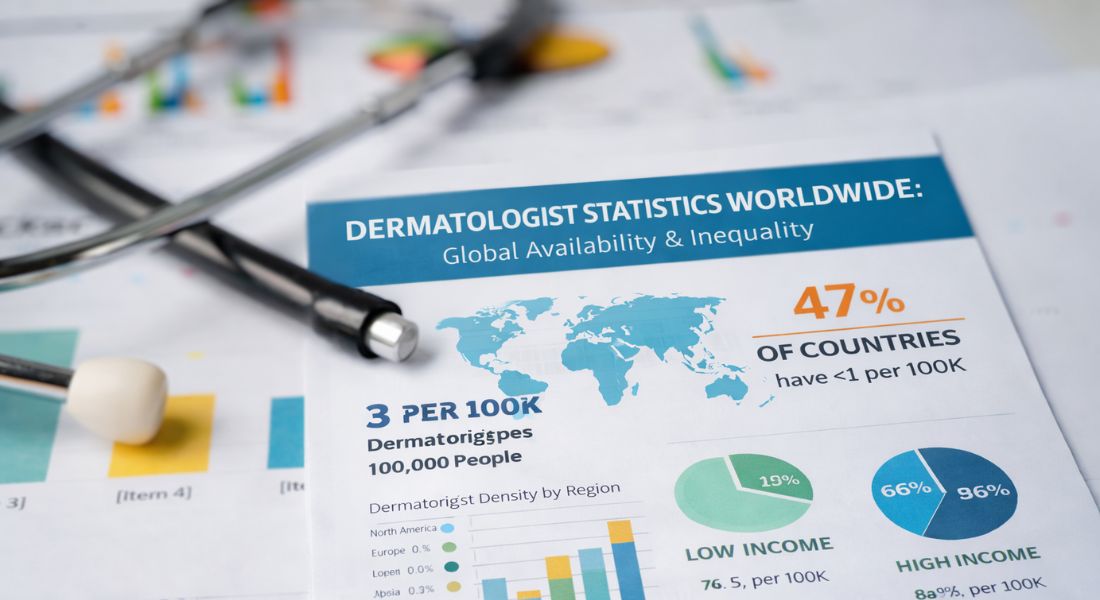
Access to dermatology care varies dramatically across the world. In some countries, patients can see a dermatologist within days, while in others, access is extremely limited or non-existent. These differences are driven by workforce distribution, healthcare funding, and training capacity.
Skin disease is one of the most common health issues globally, yet specialist availability does not reflect this burden. Dermatology services are unevenly distributed between high-income and low-income regions. Statistics reveal a clear global inequality in access.
This article explores dermatologist statistics worldwide. We examine dermatologist-to-population ratios, regional disparities, growth trends, and what the data reveals about global skin healthcare inequality.
Estimated Number of Dermatologists Worldwide
Globally, there are an estimated 200,000–230,000 practising dermatologists. Most of these specialists are based in high-income countries, particularly in North America, Europe, and parts of East Asia. In contrast, low- and middle-income countries account for a much smaller share of the global dermatology workforce. This creates a stark imbalance in specialist availability.
The uneven distribution has practical consequences for patient care. In many regions, skin conditions are managed by general practitioners or non-specialist clinicians. Access to trained dermatologists is limited or absent in large parts of the world. Specialist dermatology care is therefore far from universal.
These figures highlight a mismatch between workforce supply and global need. Skin disease contributes significantly to worldwide disease burden. Yet specialist availability does not reflect this reality. The numbers underline global inequality rather than adequacy.
Global Dermatologist-to-Population Ratios
Dermatologist availability is commonly measured per 100,000 people. Globally, the average is estimated at 2–3 dermatologists per 100,000 population. At first glance, this may seem reasonable. However, this single figure hides wide global variation.
In high-income countries, you may find more than 10 dermatologists per 100,000 people. In contrast, many low-income regions have fewer than 0.1 per 100,000, or none at all. This gap reflects access inequality rather than differences in skin disease prevalence. Clinical need exists everywhere, but specialist availability does not.
Because of this, global averages can be misleading. They smooth out extremes that patients actually experience on the ground. To understand access properly, you need to look at regional and national ratios, not worldwide means. The statistics point to structural imbalance, not uniform provision.
Dermatologist Availability by World Region
Access to dermatology care depends heavily on where you live. Workforce statistics show clear regional concentration rather than even global distribution. Some parts of the world have dense specialist coverage, while others have almost none. These differences shape how quickly you can access diagnosis, treatment, and specialist advice.
| Region | Approx. Dermatologists per 100,000 |
| North America | 10–15 |
| Western Europe | 7–12 |
| Eastern Europe | 3–6 |
| Latin America | 1–3 |
| Asia (average) | <1 |
| Sub-Saharan Africa | <0.1 |
These figures show that geography strongly determines access. Skin disease prevalence does not follow this pattern.
High-Income vs Low-Income Country Comparison
High-income countries account for the majority of the world’s dermatologists. Strong training infrastructure, specialist funding, and established referral systems support workforce growth. As a result, you are more likely to access timely specialist care in these settings. Workforce density is consistently higher across Europe, North America, and parts of East Asia.
In low-income countries, dermatologist numbers remain extremely limited. Health systems prioritise acute and life-threatening conditions, often leaving skin disease under-resourced. Specialist training programmes are few, and workforce expansion is slow. This means you may rely on general practitioners or non-specialists for dermatological care.
These differences create a clear two-tier global reality. Access to dermatology depends heavily on where you live rather than clinical need. The statistics show inequality driven by system capacity, not disease prevalence. Location, not diagnosis, often determines care availability.
United States Dermatologist Statistics
The United States has one of the highest dermatologist densities globally. Estimates place availability at around 12–15 dermatologists per 100,000 population. This figure far exceeds global and European averages. Urban and metropolitan regions account for the highest concentration of specialists.
However, high national density does not translate to equal access. Rural and remote areas remain significantly underserved. Many counties have no practising dermatologist at all. Geographic distribution creates access gaps despite strong overall numbers.
Insurance coverage further shapes access. Patients without adequate insurance may face long waits or limited provider options. Workforce size alone does not resolve access barriers. Distribution and healthcare structure are equally influential.
European Dermatology Workforce Overview
Western Europe demonstrates relatively strong dermatologist availability. Countries such as Germany, France, and Italy report dermatologist-to-population ratios often exceeding 8 per 100,000. These figures reflect long-established training systems and sustained healthcare investment. Specialist access is generally better in urban centres.
Eastern Europe shows lower dermatologist density, though gradual improvement is evident. Expanded training programmes have increased workforce numbers over time. Despite this progress, shortages remain in rural and economically disadvantaged regions. Regional imbalance continues to affect access.
Europe illustrates how policy commitment influences workforce growth. Investment in training and retention supports gradual expansion. However, progress is slow and requires long-term planning. Short-term solutions remain limited.
Dermatologist Statistics in Asia
Asia holds the largest share of the global population but a disproportionately small share of dermatologists. In many Asian countries, dermatologist density remains below 1 per 100,000 population. This shortfall is particularly evident in low- and middle-income nations. Population size magnifies workforce limitations.
Specialists are heavily concentrated in major cities. Urban centres offer better access to dermatology services and advanced care. Rural and semi-urban populations often depend on general practitioners. Specialist access outside cities remains limited.
Intra-country inequality is a defining feature of dermatology access in Asia. Even where overall numbers are improving, distribution remains uneven. Workforce growth has not matched population growth. Statistics consistently show demand exceeding supply.
Dermatology Access in Africa
Across Africa, access to dermatology services varies widely, but overall availability remains extremely limited. Workforce shortages and restricted training pathways have created major gaps in specialist skin care. The data highlights some of the most pronounced inequalities seen globally.
- Sub-Saharan Africa has the most severe dermatologist shortage worldwide: In several countries, there are fewer than one dermatologist per million people, leaving vast populations without access to specialist assessment.
- Specialist dermatology care is extremely limited: Many regions rely on general practitioners or non-specialist clinicians to manage complex skin conditions due to the absence of trained dermatologists.
- Skin infections and inflammatory conditions are highly prevalent: Despite the high burden of disease, specialist diagnosis and treatment are rarely available, particularly in rural and underserved areas.
- Training programmes remain scarce: Limited local training opportunities restrict workforce growth, reinforcing long-term access challenges.
These statistics illustrate the sharpest global inequality in dermatology access. The combination of high disease burden and minimal specialist availability creates critical care gaps. Addressing training and workforce capacity remains central to improving skin health outcomes across the region.
Latin America Dermatologist Distribution
Latin America demonstrates moderate dermatologist availability when viewed at a regional level. Most specialists are concentrated in large cities and capital regions. Urban populations generally experience better access to dermatology care. Rural and remote areas remain consistently underserved.
Dermatologist-to-population ratios across the region typically range from 1 to 3 per 100,000 people. These figures sit below those seen in many high-income countries. Private dermatology services account for a substantial share of care delivery. Public systems often face capacity constraints.
Regional variation is a defining feature of access. Some countries have relatively stable specialist numbers, while others face persistent shortages. Inequality exists both between countries and within national borders. Statistics reflect structural imbalance rather than temporary gaps.
Dermatologist Growth Trends Globally
Global data shows that growth in the dermatology workforce is uneven across regions. While some countries continue to expand specialist numbers, others struggle to increase capacity at the same pace. These trends help explain ongoing access disparities.
- High-income countries show steady workforce expansion: Many wealthier nations continue to train and recruit dermatologists at a consistent rate, improving overall access to specialist care.
- Low-income regions experience much slower growth: In contrast, workforce expansion in lower-income settings remains limited, widening the gap in dermatology access.
- Training capacity is the primary constraint: Dermatology requires lengthy specialist training, and limited educational infrastructure restricts how quickly new specialists can enter the workforce.
- Resource limitations slow long-term progress: Financial constraints, staffing shortages, and competing healthcare priorities all reduce the ability to expand training programmes.
These growth patterns suggest that global inequality in dermatology access is likely to persist. Increasing specialist numbers alone is not enough without broader policy support. Sustainable change requires coordinated investment in training, infrastructure, and workforce planning.
Skin Disease Burden vs Workforce Availability
Skin disease is one of the most common health problems worldwide, affecting millions of people every year. You see this across conditions like eczema, skin infections, acne, and skin cancer. Despite how widespread these issues are, skin health is often treated as a lower priority in healthcare planning. This creates a gap between how common skin disease is and how seriously it is addressed.
In many parts of the world, the areas where skin disease is most common are the same places with the fewest trained specialists. If you live in these regions, access to a dermatologist can be extremely limited or non-existent. As a result, early diagnosis and timely treatment are often missed. This delay can allow manageable conditions to become far more serious.
When you look at the data, the imbalance is clear. The distribution of the dermatology workforce does not match where the need is greatest. This poor alignment between demand and access leads to worse health outcomes overall. Until workforce planning reflects disease burden, these gaps are likely to persist.
Urban vs Rural Dermatology Inequality
Even within the same country, where you live plays a huge role in the skin care you can access. Dermatology services tend to cluster in major cities, where hospitals, private clinics, and career opportunities are concentrated. If you live in a rural or remote area, finding a specialist can be far more difficult. This urban–rural divide creates a clear and persistent inequality in dermatology care.
| Area Type | Typical Access Level |
| Major cities | High |
| Suburban regions | Moderate |
| Rural areas | Low |
This pattern is consistent worldwide. Geography strongly influences care.
Role of Private Dermatology Worldwide

Private dermatology plays a major role in skin care across the world. In many countries, public health systems simply do not have the resources to meet demand. When this happens, private clinics step in to fill the gaps. However, for you as a patient, cost can quickly become a major barrier.
In low-income countries, private dermatology services are often out of reach for most people. If you cannot afford care, specialist treatment may not be an option at all. In higher-income countries, private clinics tend to shorten waiting times rather than replace public services. This can make access faster, but not necessarily fairer.
The growth of private dermatology reflects a level of unmet demand that public systems are struggling to manage. When you look at the statistics, rising private provision often mirrors long NHS or public-sector waiting lists. This trend highlights increasing pressure on health systems worldwide. Without wider investment, reliance on private care is likely to continue.
Dermatology Training Capacity Worldwide
Dermatology training capacity is heavily concentrated in wealthier countries. In many parts of the world, you’ll find very few training programmes or no dermatology residency positions at all. This lack of opportunity limits how many specialists can be trained locally. Over time, it slows workforce growth and restricts access to care.
International training and migration further deepen this imbalance. Many doctors train in lower-income countries and then relocate to higher-income regions for better pay and working conditions. If you live in a country losing trained specialists, this “brain drain” can severely weaken local services. The result is a growing gap between where dermatologists are trained and where they are most needed.
Ultimately, training capacity shapes the future of dermatology access. When investment in education is limited, shortages persist for decades. The statistics point to long-term challenges rather than short-term fixes. Without expanding training pathways globally, inequality in skin care will continue.
Teledermatology as a Partial Solution

Teledermatology has grown rapidly in response to global access challenges. Data shows it plays a useful role in triage and service efficiency. However, its impact on wider equity remains limited.
- Teledermatology has expanded across many healthcare systems: Image-based consultations are increasingly used to assess urgency and prioritise referrals, particularly where specialist access is limited.
- Remote areas benefit from improved initial access: Teledermatology allows patients in underserved or rural regions to receive earlier assessment than would otherwise be possible.
- Teledermatology does not replace specialist expertise: Accurate diagnosis and complex decision-making still depend on trained dermatologists, particularly for cancer and inflammatory disease.
- Treatment access remains constrained by workforce shortages: While triage may improve, limited specialist availability continues to restrict definitive care.
Current data suggests teledermatology improves efficiency rather than equity. It helps services manage demand but does not resolve underlying access gaps. Workforce capacity remains the central limiting factor in dermatology care worldwide.
Gender Distribution in Global Dermatology
Globally, dermatology has a relatively high proportion of female clinicians, and this trend continues to grow. In many regions, women now make up around 50–65% of dermatology trainees. This shift reflects changing career preferences and improved access to specialist training. However, it also means workforce planning needs to look beyond simple headcounts.
Patterns of workforce participation vary, particularly when part-time work is taken into account. If more clinicians choose flexible or reduced hours, overall service capacity may be lower than the raw numbers suggest. For you as a patient, this can still translate into longer waits or limited appointment availability. Gender trends therefore play an important role in realistic workforce modelling.
Impact of Ageing Populations Worldwide
Ageing populations are driving a sharp increase in demand for dermatology care. As you get older, the risk of skin cancer, chronic wounds, ulcers, and long-term inflammatory conditions rises. This pattern is being seen across the world, not just in high-income countries. As a result, demand for specialist skin care continues to grow.
Countries with rapidly ageing populations are under particular pressure. In many places, workforce growth has not kept pace with demographic change. If you live in one of these countries, access to dermatology services may become increasingly limited. Waiting times and referral delays are already widening.
The statistics show that demand is accelerating faster than supply. Even where services exist, capacity is often stretched. For you as a patient, this imbalance can mean delayed diagnosis and treatment. Without strategic planning, these access gaps are likely to continue growing.
International Comparison of Dermatologist Density
When you compare countries globally, the gap in dermatologist availability becomes very clear. High-income nations have many more specialists per head of population, while lower-income countries often have only a handful, or none at all. These differences are not accidental; they reflect deeper structural inequalities in healthcare systems. How much a country invests in health care strongly shapes the level of access you can expect.
| Country Group | Avg. Dermatologists per 100,000 |
| High-income | 8–15 |
| Upper-middle income | 2–5 |
| Lower-middle income | <1 |
| Low-income | <0.2 |
These differences reflect structural inequality. Healthcare investment strongly predicts access.
What Global Statistics Reveal About Inequality
Global dermatology statistics reveal deep and persistent inequality. Where you live and how wealthy your country is often matter more than how severe the disease burden may be. In many regions, access to care is shaped by income level rather than clinical need. This makes inequality a structural issue, not an individual one.
When specialists are scarce, early diagnosis becomes much harder. For you as a patient, this can mean delayed detection of skin cancer or poor control of chronic skin conditions. Outcomes are strongly influenced by whether specialist care is available at the right time. These gaps directly affect long-term health and survival.
The numbers point to injustice rather than coincidence. Patterns repeat across countries, income groups, and health systems. This shows that inequality in dermatology access is systemic and deeply embedded. Without structural change, the statistics are unlikely to improve.
What These Figures Mean for Patients
Global dermatology statistics help explain why patient experiences differ so widely across regions. Access to care, waiting times, and outcomes are strongly influenced by where you live. Understanding this context makes individual experiences easier to interpret.
- Patient experiences vary significantly by geography: Access to dermatology services differs widely between countries and regions, shaping how quickly patients are seen and treated.
- Waiting times reflect system capacity, not personal priority: Delays are usually the result of workforce and structural constraints rather than individual circumstances.
- Outcomes are linked to access and timeliness of care: Earlier assessment and treatment often lead to better outcomes, highlighting the importance of service availability.
- Understanding the data supports informed decision-making: Awareness of these patterns helps patients set realistic expectations and engage more confidently with their care options.
These figures make clear that global inequality in dermatology access remains a major challenge. Data highlights how systemic factors shape patient journeys. Recognising this reality is an important step towards meaningful change.
FAQs:
1. Why does access to dermatologists vary so widely between countries?
Because dermatologist availability depends on economic resources, healthcare infrastructure, and specialist training capacity, not population need alone. Global inequality, rather than isolated system failure, drives most access gaps.
2. How is dermatologist availability measured internationally?
It’s most commonly measured using the dermatologist-to-population ratio per 100,000 people. However, this metric masks real-world access issues such as urban concentration, private practice dominance, and regional isolation.
3. Do high-income countries always have good access to dermatology care?
Not necessarily. Even in high-income countries, dermatologists are often concentrated in cities and private clinics, leaving rural areas and public systems underserved despite strong national averages.
4. What happens in countries with very few dermatologists?
Patients rely heavily on general practitioners or nurses to manage complex skin disease. This leads to delayed diagnosis, mismanagement, and preventable complications, particularly for chronic inflammatory disease and skin cancer.
5. Why is dermatology often overlooked in global health policy?
Skin disease is frequently misclassified as cosmetic or non-urgent. This perception affects funding, training positions, and workforce planning, despite dermatology being a major driver of healthcare consultations worldwide.
6. How does urban concentration affect dermatology access?
Dermatologists cluster in cities due to infrastructure, career opportunities, and financial incentives. This creates stark disparities where rural populations face long waits, limited continuity, and reduced diagnostic accuracy.
7. What role does global migration of dermatologists play in inequality?
Dermatologists trained in lower-income countries often move to wealthier nations, improving care there while worsening shortages at home. This deepens existing global and regional inequities in skin healthcare access.
8. Is there a mismatch between skin disease burden and dermatologist supply?
Yes. Many regions with the highest burden of infectious and inflammatory skin disease have the fewest specialists, while areas with lower disease burden often have an oversupply of dermatologists.
9. Can teledermatology solve global access problems?
Teledermatology improves triage and reach, especially in remote areas, but it cannot replace in-person specialist care. Accurate diagnosis, procedures, and long-term management still depend on physical examination.
10. What do global dermatologist shortages mean for patient outcomes?
Limited access leads to delayed diagnosis, chronic disease progression, poorer cancer outcomes, and increased psychological burden. Where access is constrained, inequality in care directly translates into inequality in health outcomes.
Final Thoughts: Real-World Implications of Dermatology Access
Global dermatologist statistics aren’t just numbers they show who gets timely diagnosis and who waits until disease becomes chronic or disfiguring. Access, shaped by geography, wealth, and policy, often determines patient outcomes more than the condition itself. Even in high-income countries, urban concentration and private sector growth leave many underserved, and in lower-income regions, severe shortages magnify avoidable suffering.
Digital tools and awareness campaigns provide limited relief, but nothing replaces specialists on the ground. If you’d like to book a consultation with one of our dermatologists in London, you can contact us at the London Dermatology Centre. Working with an experienced Dermatologist in London ensures timely, evidence-led care in a system designed for patient outcomes and equity.
References:
- Prasad, S., 2021. Dermatology on the global stage: The role of dermatologists in global health. House of Medicine and Dermatology https://pmc.ncbi.nlm.nih.gov/articles/PMC8539819/
- Marco‑Ibáñez, A. et al., 2024. Virtual Consultation in Dermatology: Access Inequalities and Geographic Factors Affecting Dermatology Care https://www.mdpi.com/2227-9032/12/6/659
- Ouellette, S. et al., 2022. Usefulness of Smartphones in Dermatology: A US‑Based Evaluation (MDPI). International Journal of Environmental Research and Public Health, https://www.mdpi.com/1660-4601/19/6/3553
- Alfawzan, A. et al., 2022. Dermatology workforce over a decade in Saudi Arabia: demographics, distributions, and future challenges. https://pmc.ncbi.nlm.nih.gov/articles/PMC8959278/
- Glazer, A.M., et al., 2025. Geospatial analysis of dermatologist distribution and access among US seniors. JAAD International, https://www.sciencedirect.com/science/article/pii/S2666328724001548