



Vitiligo treatment has changed considerably as researchers have learned more about the immune processes involved in loss of skin pigmentation. Treatments that once relied mainly on broad anti-inflammatory medicines and ultraviolet light can now include a medicine designed to target a specific immune-signalling pathway involved in non-segmental vitiligo.
This progress has developed over decades rather than through one breakthrough. Corticosteroids, phototherapy, calcineurin inhibitors, targeted light and, more recently, topical JAK inhibition have each changed what may be offered to you. However, no treatment guarantees complete or permanent repigmentation, and your response can depend on the type, location, duration and activity of your vitiligo.
Understanding What Happens in Vitiligo
Vitiligo is a chronic condition in which an autoimmune response plays a major role in the loss of functioning melanocytes, the cells that normally produce pigment in your skin. This understanding has been important because it helped researchers identify immune pathways that could potentially be modified with treatment.
Modern treatment therefore has two broad aims: helping control ongoing disease activity and, where possible, encouraging repigmentation from surviving melanocytes or melanocyte reservoirs. Your ability to repigment varies between body sites and individuals, so controlling immune activity does not guarantee complete restoration of your previous skin colour.
Early Treatment Was Often Unpredictable
For many years, treating vitiligo could be frustrating because no single therapy worked consistently for everyone, and different areas of your body could respond very differently. This made it difficult to predict how much repigmentation you might achieve with a particular treatment.
Researchers therefore explored different medicines and forms of ultraviolet light to find ways of slowing pigment loss and encouraging repigmentation. These early approaches helped build the foundation for the more targeted treatment options available today.
Psoralen and Light Treatment Came Before Modern Corticosteroids
The history of light-based vitiligo treatment extends much further back than modern dermatology. Historical accounts describe plant preparations containing naturally occurring psoralens being combined with sunlight in ancient India and Egypt. Modern development accelerated during the twentieth century as psoralen compounds were isolated and used more systematically with ultraviolet exposure.
Modern PUVA treatment developed during the mid-twentieth century by combining a psoralen photosensitiser with controlled UVA exposure. Although PUVA later became an important treatment for vitiligo, it has largely been displaced by narrowband UVB in current UK practice because NB-UVB avoids psoralen and generally has a more favourable treatment profile.
Corticosteroids Became an Important Treatment
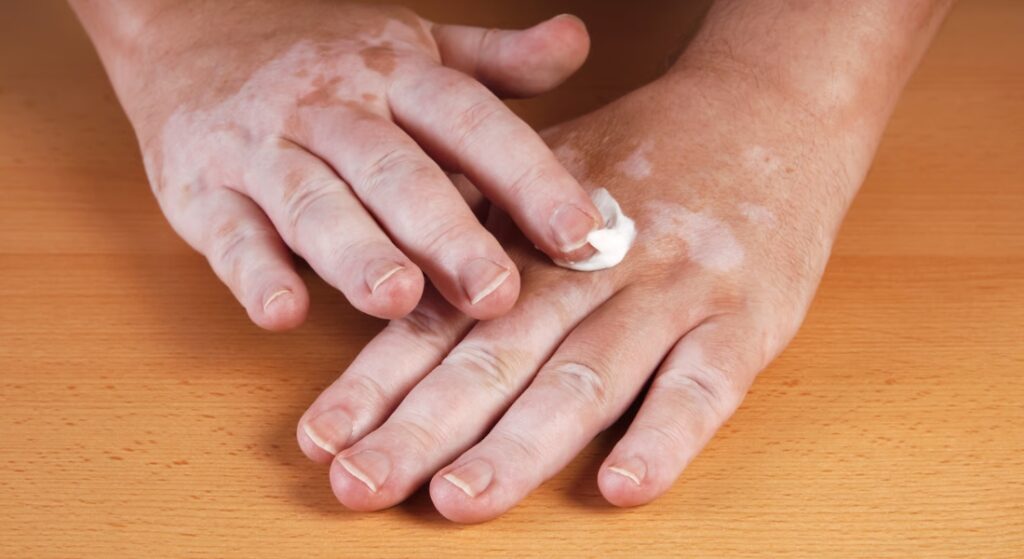
Topical corticosteroids became an important way of suppressing local immune and inflammatory activity in vitiligo. A small 1976 study involving 20 patients provided early clinical and microscopic evidence that corticosteroid treatment could stimulate repigmentation in selected areas, although the response was far from universal.
Over time, stronger evidence and clinical experience established topical corticosteroids as an important option. Current British Association of Dermatologists guidance recommends a potent or very potent topical corticosteroid once daily as first-line treatment for appropriate vitiligo, while avoiding areas such as the skin immediately around your eyes.
Steroids Had Practical Limitations
Topical corticosteroids can help treat inflammation, but prolonged or inappropriate use may cause side effects such as skin thinning. Your dermatologist will consider the steroid strength, treatment area and duration of use.
- Skin thinning: Long-term use can make treated skin thinner.
- Treatment duration: Your dermatologist considers how long you need treatment.
- Sensitive areas: Extra care is needed when treating thinner or more sensitive skin.
- Intermittent use: Corticosteroids may be used in planned treatment periods.
- Alternative treatments: Options such as topical calcineurin inhibitors may be considered.
These limitations helped encourage safer, more flexible treatment approaches. Your dermatologist can review your treatment regularly and adjust it when needed.
Phototherapy Expanded Treatment Possibilities
PUVA combined a psoralen medicine with UVA radiation and became an important form of modern vitiligo phototherapy. It demonstrated that controlled ultraviolet exposure could help encourage repigmentation, but treatment could be burdensome and psoralen introduced additional adverse effects and practical considerations.
As narrowband UVB developed, it increasingly replaced PUVA for many patients. Current UK guidance recommends NB-UVB as the first-line form of phototherapy when topical treatment has provided an inadequate response or when your vitiligo is extensive or progressive; PUVA is generally considered in adults when NB-UVB is unavailable or has been ineffective.
Narrowband UVB Became a Major Advance
Combining treatments became an important area of vitiligo research because reducing local inflammation while stimulating repigmentation may offer greater benefits than either approach alone. The UK HI-Light trial studied 517 adults and children aged 5 years and over with active, limited vitiligo and found that combination treatment produced the highest rate of successful treatment after nine months.
Findings From the UK HI-Light Trial
| Treatment | Participants With Successful Treatment | Key Finding | Long-Term Consideration |
| Topical corticosteroid alone | 17% | Provided successful treatment in a smaller proportion of participants | Some responders later lost their response |
| Handheld NB-UVB alone | 22% | Performed better than corticosteroid alone | Response was not always maintained |
| Combination treatment | 27% | Produced the highest success rate and was statistically superior to corticosteroid alone | Repigmentation could still be lost after treatment stopped |
| Overall trial | 517 participants | Included adults and children aged 5 years and over with active, limited vitiligo | Demonstrated that treatment response can remain limited |
| Nine-month assessment | All treatment groups | Combination therapy showed the strongest results | Successful treatment was achieved in fewer than one-third of participants |
| Following year | Responders were followed without treatment | More than 40% of responders lost their response | Highlights the challenge of maintaining repigmentation |
Combining Treatments Improved the Approach

Doctors increasingly found that vitiligo treatments did not always have to be used individually. Combining different approaches could sometimes improve repigmentation by addressing the condition through more than one treatment pathway.
The UK HI-Light trial found that combining a potent topical corticosteroid with home-based handheld NB-UVB was more effective for localised vitiligo than using the topical corticosteroid alone. This helped support the use of combination treatment when it is appropriate for your individual needs.
Calcineurin Inhibitors Offered Another Option
Topical calcineurin inhibitors such as tacrolimus gave dermatologists a non-steroid way to modify immune activity in your skin. In UK vitiligo care, tacrolimus is used off-label, but BAD guidance recommends considering tacrolimus 0.1% ointment for facial vitiligo as an alternative to a potent or very potent topical corticosteroid.
A 2021 randomised controlled study involving 42 adults with facial vitiligo found that 65% of those treated with tacrolimus 0.1% achieved at least 75% repigmentation of the target lesion after 24 weeks, compared with none receiving vehicle treatment. The results support its usefulness in selected patients, but they should not be interpreted as applying to every body site or every type of vitiligo.
Targeted Light Treatment Became Possible
The development of 308-nm excimer lasers and lamps allowed therapeutic light to be directed specifically at individual vitiligo patches. This can reduce unnecessary exposure of surrounding unaffected skin compared with whole-body phototherapy.
Current BAD guidance says excimer laser or light can be considered for localised vitiligo, particularly in combination with a topical calcineurin inhibitor. However, this form of treatment is not widely available through the NHS and is generally limited to centres with a specialist interest.
Surgical Treatments Developed in Parallel
Not every advance in vitiligo treatment involved medicines or light. Techniques such as blister grafting and melanocyte-containing cell suspensions were also developed to transfer functioning pigment cells into selected areas of stable vitiligo.
These procedures are not appropriate for active or rapidly changing disease. Current BAD guidance says cellular grafting may be considered for stable segmental or non-segmental vitiligo that has not responded to other treatments and continues to cause distress, although these techniques are available in only a limited number of specialist NHS centres.
Research Shifted Towards the Immune System
As vitiligo research became more detailed, scientists identified an important role for immune signalling involving interferon-gamma and the JAK-STAT pathway. These signals help recruit and maintain immune cells that attack melanocytes within affected skin.
This offered researchers a more precise therapeutic target. Instead of suppressing inflammation broadly, medicines could potentially interrupt a specific signalling pathway involved in maintaining the autoimmune response, helping lead to the development of topical ruxolitinib.
JAK Inhibitors Opened a New Chapter
Janus kinase inhibitors became an important research focus because JAK signalling lies downstream of immune pathways involved in non-segmental vitiligo. Several JAK inhibitors have been investigated, but this does not mean that every medicine in the class is licensed or recommended for vitiligo.
Ruxolitinib cream inhibits JAK1 and JAK2 and became the first treatment specifically approved for non-segmental vitiligo with facial involvement in adults and adolescents aged 12 years and over. Its development represented a shift towards targeting a defined immune-signalling pathway rather than relying entirely on broader anti-inflammatory treatments.
Large Trials Confirmed the Potential of Ruxolitinib
Two phase 3 studies, TRuE-V1 and TRuE-V2, enrolled 674 people aged 12 years or over with non-segmental vitiligo affecting no more than 10% of their total body surface area. Participants applied ruxolitinib 1.5% cream or vehicle twice daily for 24 weeks before all participants could receive ruxolitinib through week 52.
At week 24, at least 75% improvement in facial vitiligo scores was achieved by 29.8% of people receiving ruxolitinib compared with 7.4% receiving vehicle in TRuE-V1, and by 30.9% compared with 11.4% in TRuE-V2. Repigmentation continued to improve for some people with longer treatment, but these results also show that a major response is not guaranteed.
Ruxolitinib Received European Authorisation
The European Commission authorised Opzelura in April 2023 for non-segmental vitiligo with facial involvement in adults and adolescents aged 12 years and over. Current UK product information carries the same indication.
Authorisation was important because ruxolitinib was developed specifically around a molecular pathway involved in vitiligo rather than being an older medicine used off-label. However, regulatory authorisation and NHS funding are separate steps, which is why access in England developed later.
Access in England Reached Another Milestone
On 24 February 2026, NICE announced its recommendation of ruxolitinib cream as the first licensed vitiligo treatment recommended for NHS use in England. Final technology appraisal guidance, TA1140, was then published on 17 March 2026.
The NHS recommendation is narrower than the medicine’s full marketing authorisation. NICE recommends ruxolitinib for people aged 12 years and over with non-segmental vitiligo involving the face only when topical first-line treatments have not worked or are unsuitable and the company provides the medicine under the agreed commercial arrangement. NICE anticipates that treatment will be prescribed, supplied and monitored in secondary care.
What Should You Know About Ruxolitinib Today?
Ruxolitinib cream should be initiated and supervised by a doctor experienced in diagnosing and treating non-segmental vitiligo. Current UK product information recommends applying a thin layer twice daily, at least eight hours apart, to depigmented areas covering no more than 10% of your body surface area. Satisfactory repigmentation may require treatment beyond 24 weeks, and stopping treatment should be considered if there is less than 25% repigmentation in treated areas at week 52.
Ruxolitinib cream is contraindicated during pregnancy and breastfeeding. Non-melanoma skin cancers have been reported in people using topical ruxolitinib, although a causal relationship has not been established, so periodic skin examination is recommended, particularly if you have relevant risk factors. You should use the medicine as prescribed and should not independently combine it with other treatments on the same areas.
Vitiligo Treatment Is Not Only About Repigmentation
Treatment does not have to mean actively trying to restore colour to every patch. Your preferences, how much the condition affects you and the likelihood of a particular area responding should all be part of the decision. Some people may prefer observation, sun protection or skin camouflage rather than active repigmentation treatment.
Vitiligo can also have a significant psychological and social impact. BAD guidance recommends considering your quality of life and psychological wellbeing, offering self-help information where appropriate and referring for psychological support when distress is moderate or severe.
Why Specialist Assessment Still Matters

Your most appropriate treatment depends on factors including whether your vitiligo is segmental or non-segmental, whether it is stable or progressing, which areas of your body are affected, how extensive it is and which treatments you have previously tried. Your dermatologist should also consider its effect on your quality of life and any relevant autoimmune or medical history.
If you are considering specialist vitiligo treatment in London with an experienced dermatologist, your consultation can help you understand which established or newer treatments may be appropriate and what level of repigmentation is realistic for the areas affecting you.
Vitiligo Research Is Still Moving Forward
Researchers continue to investigate additional JAK inhibitors, longer-term treatment strategies and combinations intended to improve the extent or durability of repigmentation. A recently published exploratory phase 2 study found encouraging results when NB-UVB was added to ruxolitinib cream in selected people who had shown limited early improvement.
However, you should not interpret this as an established treatment combination. Current UK product information states that the efficacy and safety of ruxolitinib cream combined with NB-UVB have not yet been established, so no recommendation for routine combined use can currently be made.
Myth vs Fact
| Myth | What You Should Know |
| Modern vitiligo treatment started with corticosteroids. | Your history of vitiligo phototherapy reaches much further back through psoralen and light-based treatment. |
| Corticosteroids restore colour in everyone. | Your response varies considerably and the original 1976 study showed repigmentation in only some patients. |
| PUVA remains the preferred light treatment. | Your current UK phototherapy pathway generally favours NB-UVB, with PUVA reserved for selected adults. |
| Tacrolimus is specifically licensed for vitiligo. | Your dermatologist may use tacrolimus off-label because UK guidance supports it in selected areas such as facial vitiligo. |
| Combination NB-UVB and steroid treatment works for nearly everyone. | Your HI-Light study showed greater success than steroid alone, but only about 27% met its primary definition of success. |
| Every JAK inhibitor can treat vitiligo. | Ruxolitinib cream is the specifically licensed JAK treatment; other JAK approaches remain under investigation. |
| Ruxolitinib restores facial pigmentation within a few weeks. | Your improvement can be gradual and treatment beyond 24 weeks may be needed. |
| Anyone aged 12 or over with vitiligo can receive NHS ruxolitinib. | Your NHS eligibility requires non-segmental vitiligo with facial involvement and failure or unsuitability of topical first-line treatment. |
| Ruxolitinib plus NB-UVB is now standard treatment. | Research is encouraging, but the combination is not currently established in the UK product information. |
| Successful repigmentation is always permanent. | Your pigmentation can be lost again after treatment stops, so long-term expectations should be discussed with your dermatologist. |
Key Takeaways
- Your modern vitiligo treatment developed gradually rather than from one discovery.
- Psoralen and light-based treatments have a history that predates modern corticosteroid therapy.
- Potent topical corticosteroids remain an established first-line option for appropriate vitiligo.
- Narrowband UVB eventually became preferred to PUVA for many people because of its efficacy and safety advantages.
- Your dermatologist may use tacrolimus for selected areas such as your face, although its use for vitiligo is off-label.
- Combining topical corticosteroid with NB-UVB can improve the chance of a useful response in some people, but treatment is not successful for everyone.
- Your response to treatment can vary substantially according to where your vitiligo affects your body.
- Ruxolitinib cream targets JAK1 and JAK2 signalling involved in non-segmental vitiligo.
- In England, NHS ruxolitinib use is more restricted than its full marketing authorisation.
- You should not combine ruxolitinib cream with NB-UVB independently because this combination is not currently established in the UK product information.
UK Guidance Note
Current UK management still includes established treatments such as potent topical corticosteroids, topical calcineurin inhibitors and NB-UVB according to your type of vitiligo, affected sites and response to previous therapy. Tacrolimus and several other established medicines are used off-label for vitiligo, whereas ruxolitinib cream is specifically licensed for non-segmental vitiligo with facial involvement from age 12.
For NHS use in England, NICE recommends ruxolitinib only when your topical first-line treatments have not worked or are unsuitable. This NHS position is narrower than its marketing authorisation, so being medically eligible under the licence does not automatically mean that you meet the NICE-funded treatment criteria.
Frequently Asked Questions
1. When did modern treatment for vitiligo begin?
Your modern treatment developed gradually. Psoralen combined with light predates modern topical corticosteroid treatment, while corticosteroids, PUVA, NB-UVB, calcineurin inhibitors and targeted medicines subsequently expanded the options available.
2. Do topical corticosteroids still have a role in your vitiligo treatment?
Yes. Current BAD guidance recommends potent or very potent topical corticosteroids as first-line treatment for appropriate vitiligo, although your dermatologist needs to consider the treated site and the risk of local side effects.
3. Why did NB-UVB become more important than PUVA?
NB-UVB does not require psoralen and has shown favourable efficacy and colour matching compared with oral PUVA. Current UK guidance therefore recommends NB-UVB as the preferred phototherapy in appropriate patients.
4. Can your topical steroid be combined with NB-UVB?
Yes, combination treatment may be appropriate in selected cases. The UK HI-Light trial found that handheld NB-UVB plus topical corticosteroid was more successful than corticosteroid alone for active, limited vitiligo, although only around one-quarter of participants achieved the trial’s definition of treatment success.
5. Is tacrolimus licensed specifically for your vitiligo?
No. Tacrolimus is used off-label for vitiligo, but BAD guidance recommends considering tacrolimus 0.1% for facial vitiligo and selected other areas as an alternative to potent topical corticosteroids.
6. What is a 308-nm excimer treatment?
Your excimer treatment directs a focused wavelength of therapeutic light towards selected vitiligo patches. BAD guidance allows it to be considered for localised disease, although availability through the NHS is limited.
7. How does ruxolitinib work for your vitiligo?
Ruxolitinib inhibits JAK1 and JAK2, reducing signalling downstream of immune pathways implicated in melanocyte destruction. This can allow repigmentation to develop in some people with non-segmental vitiligo.
8. Who can receive ruxolitinib for vitiligo on the NHS in England?
NICE recommends it for people aged 12 years and over with non-segmental vitiligo involving the face when topical first-line treatments have not worked or are unsuitable.
9. Does ruxolitinib work quickly for everyone?
No. In the phase 3 trials, around 30% of participants receiving ruxolitinib reached at least 75% improvement in facial vitiligo scores by week 24, and some continued improving with longer treatment. Your individual response cannot be predicted or guaranteed.
10. Can you combine ruxolitinib with NB-UVB?
You should not start this combination yourself. Although a recent exploratory study produced encouraging results, current UK product information says that its efficacy and safety with NB-UVB have not been established and no recommendation can currently be made.
Final Thoughts: The Evolution of Vitiligo Treatment
The history of vitiligo treatment shows a gradual shift from broad approaches such as corticosteroids and phototherapy towards treatments informed by a more detailed understanding of autoimmune signalling. NB-UVB, calcineurin inhibitors and, more recently, ruxolitinib have expanded your treatment options, but no approach guarantees complete or permanent repigmentation. If you’re considering vitiligo treatment in London, you can get in touch with us at London Dermatology Centre.
References:
- Eleftheriadou, V., Atkar, R., Batchelor, J., McDonald, B., Novakovic, L., Patel, J.V., Ravenscroft, J., Rush, E., Shah, D., Shah, R., Shaw, L., Thompson, A.R., Hashme, M., Exton, L.S., Mohd Mustapa, M.F. and Manounah, L. (2022) ‘British Association of Dermatologists guidelines for the management of people with vitiligo 2021’, British Journal of Dermatology, 186(1), pp. 18–29. Available at: https://pubmed.ncbi.nlm.nih.gov/34160061/
- Bleehen, S.S. (1976) ‘The treatment of vitiligo with topical corticosteroids. Light and electronmicroscopic studies’, British Journal of Dermatology, 94(Suppl. 12), pp. 43–50. Available at: https://pubmed.ncbi.nlm.nih.gov/773413/
- Seneschal, J., Duplaine, A., Maillard, H., Passeron, T., Andreu, N., Lassalle, R., Favary, C., Droitcourt, C., Taïeb, A. and Ezzedine, K. (2021) ‘Efficacy and safety of tacrolimus 0.1% for the treatment of facial vitiligo: a multicenter randomized, double-blinded, vehicle-controlled study’, Journal of Investigative Dermatology, 141(7), pp. 1728–1734. Available at: https://www.sciencedirect.com/science/article/pii/S0022202X21000774
- Rosmarin, D. et al. (2022) ‘Two Phase 3, Randomized, Controlled Trials of Ruxolitinib Cream for Vitiligo’, The New England Journal of Medicine, 387(16), pp. 1445–1455. Available at: https://pubmed.ncbi.nlm.nih.gov/36260792/
- Diotallevi, F., Gioacchini, H., De Simoni, E., Marani, A., Candelora, M., Paolinelli, M., Molinelli, E., Offidani, A. and Simonetti, O. (2023) ‘Vitiligo, from pathogenesis to therapeutic advances: state of the art’, International Journal of Molecular Sciences, 24(5), article 4910. Available at: https://pmc.ncbi.nlm.nih.gov/articles/PMC10003418/