


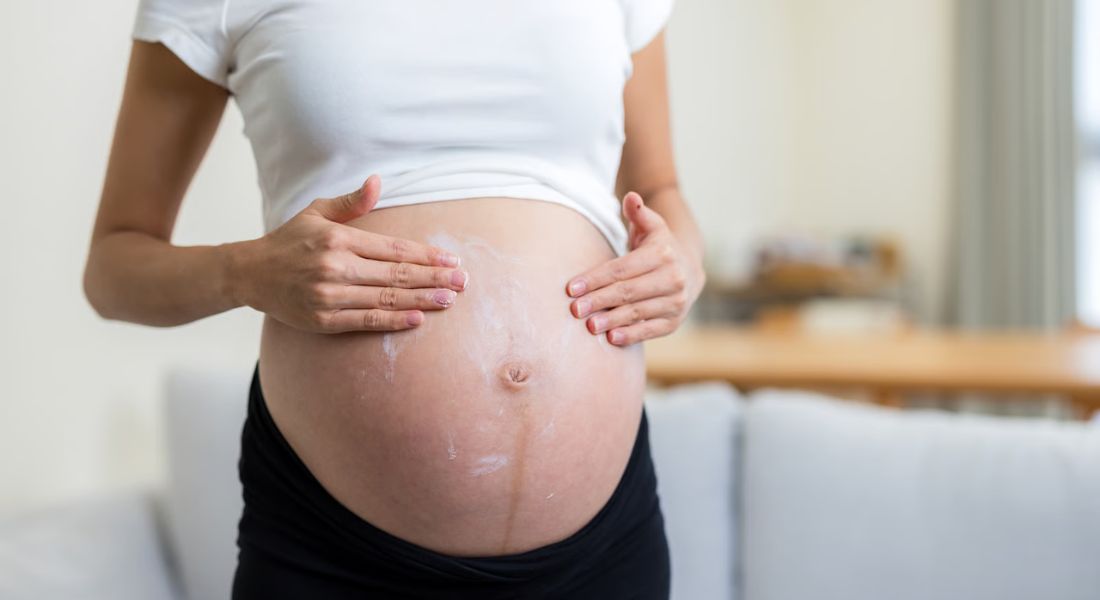
Itchy skin is common during pregnancy, especially as your abdomen grows and your skin becomes more stretched, dry or sensitive. You may notice mild irritation on areas such as your stomach, breasts or thighs without seeing an obvious rash.
Most pregnancy-related itching is caused by dry or stretching skin, heat, irritation or an existing condition such as eczema. However, very intense itching, itching that keeps you awake, itching of the palms or soles or symptoms that become worse at night need urgent maternity advice because they can be associated with intrahepatic cholestasis of pregnancy.
Call your maternity unit rather than waiting for a routine appointment when these warning signs occur. A dermatologist can assess a persistent or unusual rash, but dermatology review does not replace maternity assessment and blood tests when ICP is possible.
When Is Mild Itching Usually Considered Normal?
Mild itching during pregnancy is often linked to normal skin changes, especially when it affects areas where your skin is stretching, such as your abdomen, breasts, hips or thighs. It may improve with regular moisturising and can become more noticeable after a hot shower, in warm weather or when wearing tight clothing.
Occasional localised itching that does not disturb your sleep, spread or worsen is generally less concerning, although you should mention persistent symptoms at a maternity appointment. Contact your maternity unit urgently if the itching becomes intense, affects your palms or soles, becomes worse at night or occurs without a visible rash.
Jaundice, dark urine or pale stools also need prompt maternity assessment. Call 999 for severe breathing difficulty, swelling of your tongue or throat, collapse or reduced responsiveness rather than treating these symptoms as part of routine pregnancy itching.
Can Stretching Skin Cause Itching?
Stretching skin is a common cause of localised itching during pregnancy, especially as your abdomen grows and the skin feels tighter. This discomfort can happen even without a visible rash and is often linked with areas where stretch marks are developing, such as your abdomen, breasts, hips, thighs or buttocks.
Using a fragrance-free emollient can help reduce dryness and keep your skin more comfortable, although moisturisers cannot guarantee that stretch marks will be prevented. Try to avoid forceful scratching, as it can damage your skin and cause further irritation, while keeping your nails short and using a cool compress may help relieve the urge to scratch.
Could Dry Skin Be the Cause?
Pregnancy can make your skin drier than usual, especially if you already have sensitive or naturally dry skin. Factors such as frequent washing, central heating, cold weather and fragranced products can worsen dryness, leaving your skin feeling rough, tight, scaly or more irritated.
Using lukewarm water instead of hot showers and applying a fragrance-free emollient regularly can help support the skin barrier. A cream may suit mildly dry skin, while an ointment can provide more intensive moisturising for very dry areas; a pharmacist or clinician can help you choose an appropriate product.
Keep clothing, bedding and dressings that have absorbed any emollient away from cigarettes, candles, open fires and other naked flames. The fire risk applies to paraffin-containing and paraffin-free products because dried residue can make fabric ignite and burn more rapidly.
Can Pregnancy Make Eczema Worse?
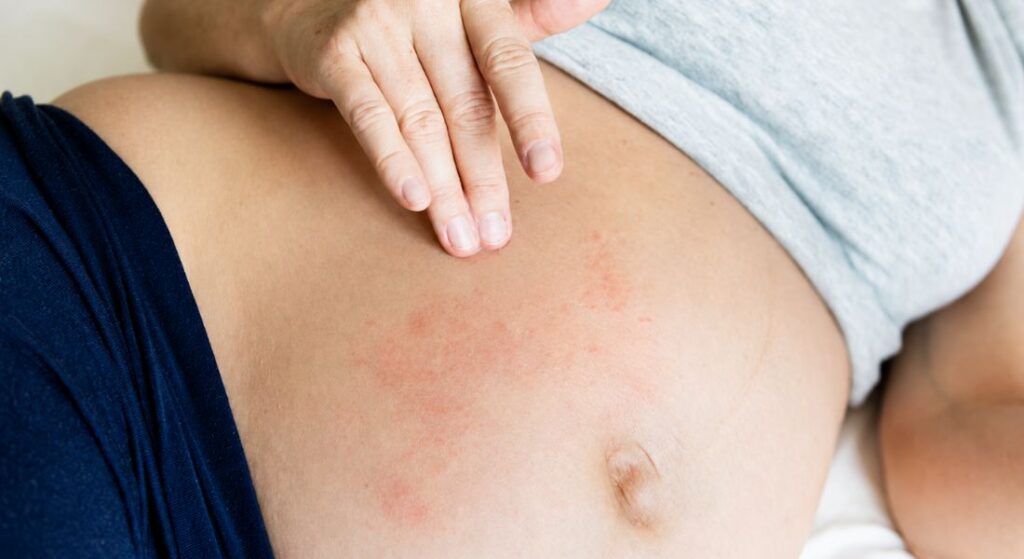
Pregnancy can sometimes make existing atopic eczema worse, although some people may notice their symptoms improve or stay the same. Hormonal changes, increased sensitivity, heat and sweating can trigger flare-ups, causing dry, inflamed and intensely itchy skin that may appear different depending on your skin tone.
Continue prescribed emollients and topical corticosteroids as directed unless your clinician advises otherwise. Tell your GP, midwife or dermatologist about every eczema medicine you use as soon as you know you are pregnant, because some oral or injected treatments need prompt review. Do not stop or change a prescription medicine without medical advice. Seek medical advice if your eczema becomes painful, swollen, blistered, crusted or develops pus-filled spots, as these signs may suggest an infection rather than a typical flare.
What Is Atopic Eruption of Pregnancy?
Atopic eruption of pregnancy refers to itchy, eczema-like skin changes that develop or become more noticeable during pregnancy. It can affect areas such as your face, neck, chest or skin folds, causing dry, inflamed patches or small, very itchy bumps on the body, and it may be more common if you or your family have a history of eczema, asthma or hay fever.
Atopic eruption of pregnancy is not generally associated with adverse effects on the baby, but it can significantly affect your comfort, sleep and skin health, particularly if repeated scratching causes skin damage or infection.
Treatment may include regular emollients, an appropriately selected topical corticosteroid or an antihistamine that is suitable during pregnancy. Seek medical advice to confirm the cause because other pregnancy-related and non-pregnancy-related conditions can look similar.
Could a New Product Be Causing Contact Dermatitis?
Contact dermatitis can happen when your skin reacts to an irritant or allergen, and pregnancy-related sensitivity may make familiar products feel uncomfortable. Common triggers include fragranced skincare, essential oils, laundry products, hair dye, adhesives, metals and cleaning chemicals, with symptoms usually appearing where the product has touched your skin.
If you notice a new rash, stop using any recently introduced non-essential product and keep your skincare routine simple. A clinician may recommend an emollient, an appropriate topical corticosteroid or further assessment according to the severity and cause of the reaction. Contact NHS 111 or an urgent medical service for a rapidly spreading rash or significant facial swelling, and call 999 for swelling of the lips, tongue or throat, serious breathing difficulty, collapse or reduced responsiveness.
What Is Polymorphic Eruption of Pregnancy?
Polymorphic eruption of pregnancy (PEP), also known as PUPPP, is an intensely itchy rash that often develops during the third trimester. It usually starts within stretch marks on your abdomen, appearing as small raised bumps that may join together and spread towards your thighs and buttocks, while the area around your belly button often remains unaffected.
PEP can cause intense discomfort, but there have been no reports of adverse effects on the baby. It usually improves after delivery. Treatment may include emollients, a prescribed topical corticosteroid and an antihistamine that is suitable during pregnancy after assessment by a healthcare professional.
Seek prompt dermatology or maternity advice if the rash begins directly around the belly button, develops several firm blisters or looks different from a typical PEP rash. Early pemphigoid gestationis can initially resemble PEP but requires different investigation and pregnancy monitoring.
Myth vs Fact
| Myth | Fact |
| All pregnancy itching is caused by the skin stretching. | Stretching can cause mild local itching, but severe, night-time or palm-and-sole itching needs maternity assessment for ICP. |
| ICP always causes a visible rash. | ICP usually causes itching without a primary rash, although scratching can produce marks and scabs. |
| A normal first blood test rules out ICP. | Itching can begin before bile acids or liver tests become abnormal, so repeat tests may be needed. |
| Every itchy abdominal rash is PEP. | PEP often starts in stretch marks and spares the belly button, while pemphigoid gestationis may begin around the belly button and later blister. |
| Paraffin-free emollients do not increase the fire risk of clothing or bedding. | Residue from paraffin-containing and paraffin-free emollients can build up on clothing, bedding and dressings, causing the fabric to ignite more easily and burn more rapidly. Keep treated fabrics away from cigarettes, naked flames and other ignition sources. |
| Reduced fetal movements can wait until the next appointment. | Any reduction or change in your baby’s usual movement pattern should be reported to the maternity unit immediately. |
What Is Pemphigoid Gestationis?

Pemphigoid gestationis is a rare autoimmune blistering condition associated with pregnancy. It often begins with severe itching and raised, inflamed skin around the belly button before spreading, with firm fluid-filled blisters sometimes developing later.
Prompt dermatology and obstetric assessment is required because diagnosis may involve a skin biopsy and blood tests, and treatment can include topical or oral corticosteroids. The condition can flare around delivery and is associated with a greater chance of premature birth or a smaller baby. A small proportion of newborn babies develop temporary blisters because maternal antibodies cross the placenta.
What Is Intrahepatic Cholestasis of Pregnancy?
Intrahepatic cholestasis of pregnancy is a liver condition in which bile acids rise during pregnancy. Its main symptom is itching without a primary rash, although repeated scratching may produce grazes, scabs or inflamed areas.
ICP usually begins later in pregnancy but can develop earlier. It may affect any part of the body and does not have to begin on the palms or soles, although these areas are commonly involved and symptoms are often worse at night. Contact your maternity unit urgently if these symptoms develop because ICP requires blood tests and an individual obstetric care plan.
How Is Intrahepatic Cholestasis Investigated?
If your healthcare professional suspects intrahepatic cholestasis of pregnancy (ICP), they will ask about your itching, including where it occurs, when it started and how severe it feels. Your skin may also be checked to rule out other causes such as eczema, pregnancy rashes or infection, while blood tests can measure bile acids and liver function.
Your first liver-function and bile-acid results may be normal even when itching has already begun. When symptoms persist and another cause has not been found, the maternity team may repeat the tests because abnormalities can develop days or weeks later.
If ICP is confirmed, your obstetric plan will consider your peak bile-acid level, stage of pregnancy and any additional pregnancy complications. ICP is associated with an increased chance of preterm birth, while the chance of stillbirth varies according to the bile-acid level and other clinical risk factors.
RCOG advises that the chance of stillbirth is higher when bile acids reach 100 micromol/L or more, particularly after 36 weeks. Your obstetric team will explain how your results affect monitoring and the recommended timing of birth.
Could an Infection or Infestation Cause the Itching?
Pregnancy does not prevent common infections or infestations such as scabies, fungal infection or chickenpox. These can produce itching or a rash that resembles a pregnancy-related skin condition, so an accurate diagnosis is important before treatment is started.
Scabies commonly causes intense night-time itching and may affect areas such as the fingers, wrists, waist, breasts or genital skin.
Telephone your GP or maternity service before attending if you develop a widespread rash, feel unwell with a rash or have been exposed to a potentially infectious rash illness. Important examples include chickenpox, measles, rubella and parvovirus B19, commonly called slapped cheek syndrome.
When Should You Arrange a Dermatology Assessment?
A dermatologist can help when you have a persistent, spreading or unclear rash, or when an existing skin condition such as eczema is not improving with your usual treatment. Specialist assessment can help identify whether your symptoms are caused by dry skin, eczema, contact dermatitis, pregnancy-specific rashes or other less common conditions.
Your maternity team should still be involved if itching is widespread, occurs without a rash or raises concerns about intrahepatic cholestasis of pregnancy (ICP), as dermatology care does not replace necessary blood tests. Bring details of your medicines, supplements and skincare products, and consider taking photographs of changing rashes, while urgent symptoms should always be assessed without delay.
Clinical Tip
Take clear photographs when the rash first appears and note where it began, whether your belly button, palms or soles are affected, whether symptoms are worse at night and whether blisters develop. Bring a list or photographs of your medicines, supplements and skincare products, but do not stop prescribed treatment unless the prescribing clinician advises you to do so.
Which Symptoms Require Urgent or Emergency Help?

Contact your maternity unit urgently for severe itching, itching that keeps you awake, itching of the palms or soles, symptoms that worsen at night or generalised itching without a rash. Jaundice, dark urine, pale stools and any change or reduction in your baby’s usual movements also require immediate maternity advice.
Seek same-day urgent medical assessment for a rapidly spreading rash, extensive blistering, peeling skin, mouth sores, fever, severe skin pain or signs of infection such as increasing warmth, swelling, pus or red streaks. Call 999 for swelling of the tongue or throat, severe breathing difficulty, collapse or reduced responsiveness.
How Can You Relieve Itching Safely?
You may ease mild skin-related itching with an unperfumed emollient, short cool or lukewarm showers, loose natural-fibre clothing and cool compresses. Pat or tap the skin instead of forcefully scratching it, keep your nails short and avoid fragranced soaps, essential oils and newly introduced active skincare products.
A pharmacist or clinician may recommend a suitable topical corticosteroid or antihistamine after considering the cause, severity and stage of pregnancy. Symptom relief does not rule out ICP, and moisturisers or antihistamines should not delay urgent maternity assessment when itching is severe, nocturnal or affects the palms or soles.
Key Takeaways
- Mild localised itching can result from dry or stretching skin, heat or eczema.
- Severe itching, night-time itching or itching of the palms or soles needs urgent maternity assessment.
- ICP generally causes itching without a primary rash, and initial blood tests may need to be repeated.
- PEP usually begins in abdominal stretch marks, while a rash around the belly button with blisters may indicate pemphigoid gestationis.
- Telephone your maternity service or GP before attending if you develop a potentially infectious rash or have been exposed to chickenpox, measles, rubella, slapped cheek syndrome or another unexplained rash illness.
- Call 999 for severe breathing difficulty, swelling of the tongue or throat, collapse or reduced responsiveness.
Frequently Asked Questions
1. Is itchy skin normal during pregnancy?
Mild localised itching can be common, particularly where the skin is dry or stretching. Contact your maternity unit urgently when itching is intense, keeps you awake, affects the palms or soles, becomes worse at night or occurs without a visible rash.
2. When should itchy skin during pregnancy be a cause for concern?
Contact your maternity unit urgently when itching is severe, worse at night, affects the palms or soles or occurs without a rash. Jaundice, dark urine, pale stools or a reduction or change in your baby’s usual movements also need immediate maternity advice.
3. Can pregnancy itching occur without a rash?
Yes. ICP typically causes itching without a primary rash and requires urgent maternity assessment with bile-acid and liver-function blood tests. A normal first test may not exclude ICP when symptoms continue, so repeat testing may be recommended.
4. What are the most common causes of itchy skin during pregnancy?
Common causes include stretching skin, dry skin, eczema, contact dermatitis, polymorphic eruption of pregnancy (PEP/PUPPP), atopic eruption of pregnancy and, less commonly, intrahepatic cholestasis of pregnancy or skin infections.
5. How can itchy skin be relieved safely during pregnancy?
Regular use of fragrance-free moisturisers, lukewarm showers, gentle cleansers, loose cotton clothing and avoiding overheating can help reduce itching. Any medicated creams or antihistamines should only be used after advice from a healthcare professional.
6. Does itchy skin during pregnancy affect the baby?
Dry skin, eczema, contact dermatitis and PEP are not generally associated with adverse pregnancy outcomes. ICP is associated with an increased chance of preterm birth, and the chance of stillbirth varies according to the bile-acid level and other pregnancy risk factors. Pemphigoid gestationis is associated with an increased chance of premature delivery or a smaller baby, so dermatology and obstetric monitoring may be required.
7. Can eczema become worse during pregnancy?
Yes. Pregnancy can trigger eczema flare-ups or make existing eczema more active. Appropriate moisturisers and prescribed topical corticosteroids can often be used safely under medical guidance.
8. Should moisturiser be used if itching is caused by stretching skin?
Yes. Fragrance-free emollients can help reduce dryness, improve skin comfort and support the skin barrier, although they cannot completely prevent stretch marks from developing.
9. Can hot showers make pregnancy itching worse?
Yes. Hot water can strip natural oils from the skin, increasing dryness and irritation. Short, lukewarm showers are generally recommended for itchy or sensitive skin during pregnancy.
10. Should a dermatologist be consulted for itchy skin during pregnancy?
A dermatologist can help with a persistent, spreading, blistering or unclear rash or an existing skin condition that is not responding to treatment. Severe itching without a rash, palm-or-sole itching, night-time itching and reduced fetal movements should be reported directly to the maternity team rather than waiting for a routine dermatology appointment.
Final Thoughts: Knowing When Pregnancy Itching Needs Attention
Mild itching during pregnancy is often caused by stretching skin, dryness or hormonal changes, but persistent, severe or widespread itching should never be ignored. Recognising the difference between common skin changes and symptoms that need prompt medical assessment can help protect both your health and your baby’s wellbeing.
If you would like personalised guidance from an experienced Dermatologist in London, the team at London Dermatology Centre is here to help. At London Dermatology Centre, our specialists work alongside your maternity team to diagnose pregnancy-related skin conditions and recommend safe, personalised care.
References:
- Alhomieed, M.F., Al Hartany, L.O., Alghorab, M.A., Alsharif, A., Kaleemullah, A., Wasaya, H.I., Alsubaie, K.A., Al Jehani, A.N., Kayali, A.M. and AlBasri, S. (2025) ‘The effect of pregnancy on dermatological disorders: A systematic review’, Clinics and Practice, 15(4), article 68. Available at: https://www.mdpi.com/2039-7283/15/4/68
- Cristescu, M.I., Tutunaru, C.V., Panaitescu, A. and Voiculescu, V.M. (2024) ‘Gestational pemphigoid From molecular mechanisms to clinical outcomes: A case report and review of literature’, Life, 14(11), article 1427. Available at: https://www.mdpi.com/2075-1729/14/11/1427
- Kumari, R., Apfelbacher, C.J., Nelson-Piercy, C. and Flohr, C. (2025) ‘The management of atopic dermatitis in women of childbearing age: Confused terminology, lack of evidence and resulting clinical inertia’, British Journal of Dermatology, 192(3), pp. 530–532. Available at: https://academic.oup.com/bjd/article-abstract/192/3/530/7819849
- McSwiney, N., Hutchison, E. and Wainman, H. (2025) ‘Pregnancy-specific dermatoses for the resident physician’, Clinical Medicine, 25(3), article 100316. Available at: https://www.sciencedirect.com/science/article/pii/S147021182500034X
- Mehta, N., Chen, K.K. and Kroumpouzos, G. (2016) ‘Skin disease in pregnancy: The approach of the obstetric medicine physician’, Clinics in Dermatology, 34(3), pp. 320–326. Available at: https://www.sciencedirect.com/science/article/abs/pii/S0738081X16300189