


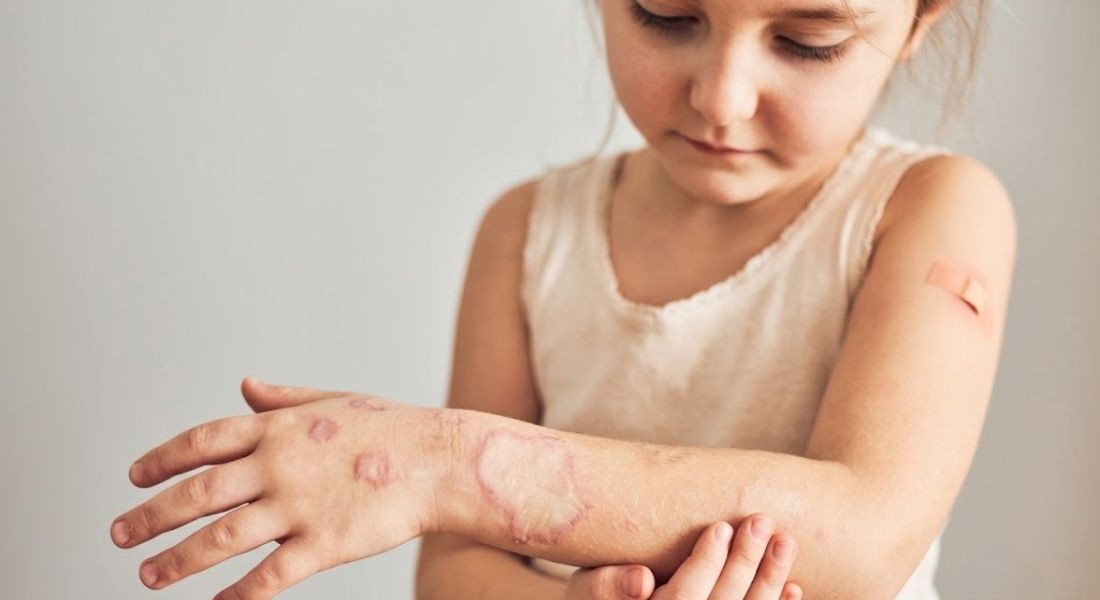
Morphea, also known as localised scleroderma, is a rare inflammatory condition that can cause your child’s skin to become hardened, thickened, shiny or discoloured. In some children, deeper tissues such as fat, muscle, joints or bone can also be affected.
You may first notice a bruise-like patch, an area of firm skin or a line of thickened tissue that does not fade as expected. Early specialist assessment can help protect your child’s skin, growth and movement before permanent changes develop.
What Is Morphea in Children?
Morphea develops when inflammation causes excess collagen to build up in your child’s skin and sometimes the tissues beneath it. This can make the affected area feel hard, tight or less flexible than the surrounding skin.
You may notice a patch, plaque, line or band of affected skin on your child’s trunk, arms, legs, face or scalp. Morphea is not contagious, so your child cannot pass it to other people through touch, swimming, school or everyday contact.
Why Is It Called Localised Scleroderma?
The word scleroderma means “hard skin”, and morphea is called localised scleroderma because the changes mainly affect your child’s skin and nearby tissues. It is different from systemic sclerosis, which can involve widespread blood-vessel and internal-organ disease.
Some deeper or facial forms can still affect your child’s joints, muscles, bones, eyes, teeth or nervous system. Your dermatologist can explain which type your child has and whether additional monitoring is needed.
How Common Is Morphea in Children?
Morphea is uncommon in childhood, with an estimated incidence of around 1 to 3 cases per 100,000 children each year. It is reported more often in girls than boys.
Because the condition is rare, you may not have heard of it before your child’s diagnosis. Early patches can resemble bruises, eczema, scars or pigmentation changes, which means some children are not diagnosed straight away.
What Can Morphea Look Like?
You may first notice a pink, purple, reddish-brown, darker or lighter patch that feels different from the surrounding skin. As the condition becomes more established, your child’s skin may become firmer, smoother, shinier or less flexible.
Deeper morphea can make an area appear slightly sunken because tissues beneath the skin may also be affected. If your child has darker skin, colour changes may remain visible even after the active inflammation has settled.
What Early Signs Might You Notice?
A morphea patch often behaves differently from an ordinary bruise because it does not gradually fade. You may notice that your child’s skin becomes harder, tighter, thicker or smoother over time.
Some children develop itching, tingling or tenderness, while others have very few symptoms. You should arrange specialist assessment if a patch is spreading, forming a line, crossing a joint or affecting your child’s face or scalp.
Morphea Signs at a Glance
The way morphea appears can vary depending on its type, location and depth. You may find it helpful to look for changes in texture and movement as well as changes in skin colour.
You do not need to wait for every feature to appear before seeking advice. If an unusual patch is becoming firmer, larger or more restrictive, your child should be medically assessed.
| What You May Notice | What It Can Mean |
| Bruise-like patch that does not fade | May represent early active morphea |
| Firm, shiny or thickened skin | Can indicate increasing collagen and skin tightening |
| Line or band on an arm or leg | May suggest linear morphea |
| Reduced movement across a joint | Deeper tissues may be involved |
| Sunken or thinner-looking area | Fat or deeper tissue may have been affected |
| Changes on the face or scalp | May require additional neurological, eye or dental assessment |
| Difference in limb size or growth | Can occur when deeper morphea affects a growing limb |
What Does Plaque Morphea Look Like?
Plaque morphea usually causes one or more oval or rounded areas of hardened or discoloured skin. Your child may have a limited patch affecting only the surface layers, although the depth should still be assessed carefully.
Topical treatment or monitoring may be suitable when your child’s disease is mild and superficial. Even after inflammation settles, some changes in colour, texture or thickness can remain.
How Can Linear Morphea Affect Your Child?
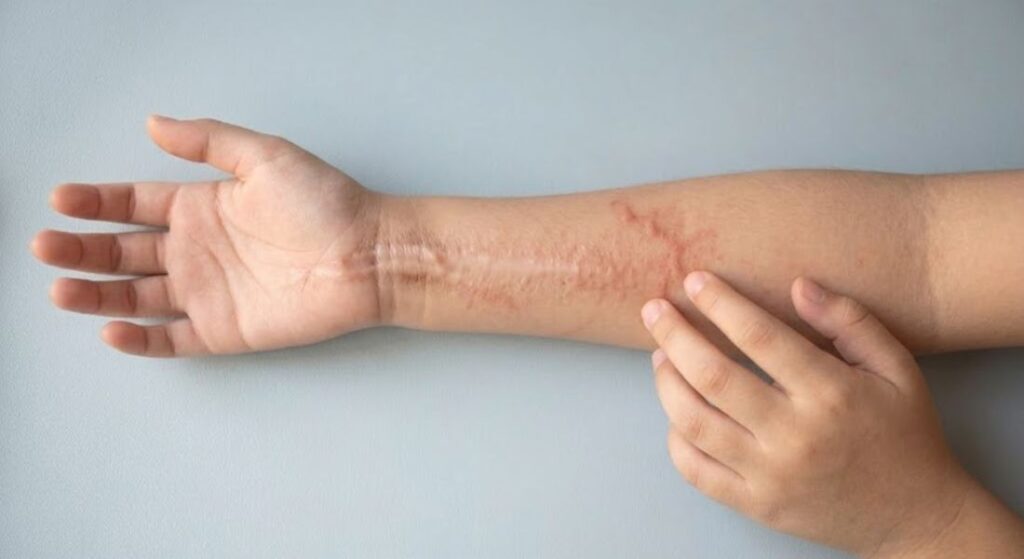
Linear morphea is the subtype most often recognised in children and usually appears as a line or band of hardened skin. You may notice it on your child’s arm, leg, trunk, face or scalp.
When a lesion crosses a joint or affects a growing limb, your child may develop reduced movement or differences in limb growth. Early treatment can therefore be particularly important for protecting function and development.
Morphea on the Face or Scalp
Morphea affecting your child’s face or scalp needs careful assessment because deeper tissues can sometimes be involved. One form, called en coup de sabre, can appear as a firm line or groove across the forehead or scalp.
Your child may need additional assessment because facial disease can occasionally involve the eyes, teeth, jaw or nervous system. European recommendations advise head MRI at diagnosis for craniofacial disease, together with eye and dental assessment where appropriate.
Can Morphea Affect Joints or Growth?
Deeper morphea can involve your child’s fat, muscle, fascia, bone or joints as well as the skin. You may notice stiffness, reduced movement, discomfort or a visible change in the shape of the affected area.
When morphea crosses a joint or affects a growing limb, your child may be at risk of contractures or differences in limb size or length. Physiotherapy and early control of inflammation can help protect movement and normal development.
What Causes Morphea?
The exact cause of morphea is not fully understood, but your child’s immune system is thought to trigger inflammation that leads to excess collagen production. Genetic and environmental factors may also contribute in some children.
Morphea is not caused by anything you or your child did, and there is no evidence that diet, hygiene or normal activities cause it. Trauma, injections or repeated friction have occasionally been reported before onset, but this does not prove that they caused the condition.
What Other Conditions Can Look Similar?
Early morphea can resemble a bruise, birthmark, scar, eczema, fungal infection or pigmentation change. You may find it difficult to tell the difference simply by looking at the skin.
A useful warning sign is a patch that does not fade normally and instead becomes firmer, larger or tighter. Your child’s dermatologist can examine the skin and decide whether further investigation is needed.
How Is Morphea Diagnosed?

Morphea is usually diagnosed through careful examination of your child’s skin. The dermatologist will look at the colour, texture, depth, location and pattern of the affected area and ask how it has changed over time.
You may also be asked about pain, itching, movement, growth, headaches, eye symptoms or joint problems. In many children, examination is enough to make the diagnosis, although additional tests may sometimes be needed.
What Tests Might Your Child Need?
An MRI scan may be recommended if your child has a lesion crossing a joint or if deeper muscle, fascia or bone involvement is suspected. Head MRI may also be advised when morphea affects the face or scalp.
A skin biopsy can help when the diagnosis remains uncertain or another condition needs to be excluded. Blood tests may occasionally be useful for associated conditions, but they cannot confirm morphea on their own.
Why Does Early Treatment Matter?
Active morphea can continue to spread or involve deeper tissues, making early treatment particularly important. If your child develops established tissue loss, stiffness or growth changes, these problems may be harder to reverse.
Treatment mainly aims to stop active inflammation rather than remove every visible mark. Your child’s skin may gradually soften, but changes in colour, thickness or contour can remain after the disease becomes inactive.
Evidence Note
A long-term study involving 133 children with juvenile localised scleroderma reported at least one relapse in 22.2% of patients, while 19.8% developed some degree of functional limitation. Delayed systemic treatment was also linked with longer disease activity and a greater likelihood of relapse.
These figures cannot predict exactly what will happen to your child because the study came from a single specialist centre. However, they support early assessment, appropriate treatment for higher-risk disease and continued follow-up.
Which Skin Treatments Might Your Child Need?
Topical treatment may be suitable when your child has mild, superficial and limited morphea. A dermatologist may prescribe a potent corticosteroid, tacrolimus ointment or another topical medicine to help reduce local inflammation.
Topical treatment is usually not enough for linear, deep or facial disease, or when a lesion threatens growth or movement. You should use any prescribed cream or ointment exactly as directed because children’s skin can be more sensitive to side effects.
When Might Your Child Need Systemic Treatment?
Systemic medicines may be recommended when your child’s morphea is deep, rapidly spreading or affecting areas where growth and movement are at risk. Methotrexate is commonly used, and corticosteroids may be added initially to control inflammation while methotrexate begins to work.
Your child will need regular reviews and blood tests while taking these medicines. If methotrexate is unsuitable or does not work well enough, treatments such as mycophenolate mofetil may be considered by the specialist team.
UK Guidance Note
European SHARE recommendations support systemic treatment for active juvenile localised scleroderma that may cause disability or disfigurement. Your child may therefore need joint care from paediatric dermatology and paediatric rheumatology when deeper tissues, joints, growing limbs or the face are involved.
Methotrexate is commonly used as first-line systemic treatment, often with a short course of corticosteroids at the beginning. If your child responds well, methotrexate is generally continued for at least 12 months before tapering is considered.
Could Phototherapy Help Your Child?
UVA1 phototherapy may be considered for selected children with superficial and relatively limited morphea. Whether it is suitable for your child depends on age, disease activity, depth and the practical burden of repeated treatment visits.
Phototherapy is not normally the main treatment when your child has active linear, deep or rapidly progressive disease. These higher-risk forms usually need systemic treatment through a specialist paediatric team.
Physiotherapy and Supportive Care

Physiotherapy can be important if morphea affects your child’s movement or a joint. A physiotherapist can provide suitable exercises to help maintain flexibility, posture and range of movement.
Moisturisers may improve comfort and dryness but do not treat the underlying inflammation. Depending on your child’s needs, other specialists such as rheumatologists, ophthalmologists, dentists, orthopaedic teams or occupational therapists may also be involved.
What Can You Expect Over Time?
Morphea can remain active for months or years before becoming inactive. Even when inflammation settles, your child may still have differences in skin colour, thickness, texture or body contour.
Regular follow-up allows the specialist to check your child’s skin, joint movement and response to treatment. Many children achieve good disease control, but relapse can occur, so continued monitoring may still be needed.
Research Insight
A 2024 review highlighted that linear and craniofacial forms are among the more challenging types of juvenile localised scleroderma. These forms can affect your child beyond the skin through musculoskeletal, neurological, eye or dental complications.
Another 2024 review found that relatively few studies measured symptoms, function and quality of life directly from children or caregivers. This means your child’s pain, mobility, school participation and everyday functioning remain important when treatment success is assessed.
Clinical Tip
Take clear photographs of your child’s affected skin in similar lighting and from the same angle between appointments. You can also make brief notes about changes in firmness, size, itching, pain or movement.
Do not rely on photographs alone if the area is spreading or beginning to affect function. You should contact the specialist team if your child develops new movement problems, headaches, vision changes or facial or scalp symptoms.
When Should You See a Paediatric Dermatology Specialist?
You should arrange an assessment if your child develops a hard or tightening patch, a bruise-like mark that does not fade or a line of thickened skin. Changes affecting the face, scalp, joints or a growing limb should be assessed particularly promptly.
A paediatric dermatologist can determine whether your child needs additional tests or multidisciplinary care. Depending on the type of morphea, treatment may include topical medicines, systemic therapy, physiotherapy, imaging and input from other specialists.
Myth vs Fact
| Myth | Fact |
| Morphea is the same as systemic sclerosis | Morphea does not cause the typical widespread internal-organ disease seen in systemic sclerosis |
| Morphea only affects the skin surface | Linear and deep forms can involve fat, fascia, muscle, joints or bone |
| Plaque morphea is the most common childhood form | Linear morphea is generally the most frequently recognised subtype in children |
| A blood test confirms morphea | Diagnosis is mainly clinical and blood tests cannot confirm it alone |
| Every child needs systemic medication | Treatment depends on activity, depth, location and complication risk |
| Phototherapy is suitable for every form | It is mainly considered for selected superficial disease |
| Treatment removes every mark | Pigmentation, thinning or contour changes may remain |
| Morphea cannot return once inactive | Relapses can occur and follow-up may still be needed |
| Facial morphea only needs skin examination | Eye, neurological and dental assessment may also be required |
Key Takeaways
- Morphea is a rare inflammatory condition that can affect your child’s skin and deeper tissues.
- It is different from systemic sclerosis and is not contagious.
- Linear morphea is the subtype most commonly recognised in children.
- A patch that spreads, hardens or forms a line should be assessed.
- Lesions affecting joints, the face, scalp or growing limbs need particular attention.
- Diagnosis is mainly clinical, with imaging or biopsy used when needed.
- Topical treatments may suit limited superficial disease.
- Methotrexate and corticosteroids are commonly used for higher-risk active disease.
- Physiotherapy can help protect your child’s movement and joint function.
- Morphea can relapse after becoming inactive, so continued follow-up may be important.
Frequently Asked Questions
1. Is morphea in children the same as systemic scleroderma?
No. Your child’s morphea mainly affects the skin and nearby tissues, whereas systemic sclerosis can involve widespread blood vessels and internal organs. Deeper or facial morphea can still affect muscles, joints, eyes, teeth or the nervous system.
2. What are the first signs of morphea in a child?
You may first notice a bruise-like patch that does not fade, firmer or shinier skin or a line of thickened tissue. Your child may also experience itching, tenderness or tightness, although some children have no discomfort.
3. Is morphea contagious?
No. Your child cannot pass morphea to another person through touch, school, swimming, shared towels or close contact because it is not an infection.
4. How is morphea diagnosed?
Your child’s dermatologist can often diagnose morphea by examining the skin and discussing how it has changed. A biopsy or MRI may sometimes be needed, while blood tests can help investigate associated conditions but cannot confirm morphea alone.
5. Can morphea affect your child’s growth?
Yes, deeper or linear morphea can sometimes affect your child’s joints, bones or growing tissues. Early treatment can help reduce the risk of differences in limb growth or long-term restrictions in movement.
6. What treatments are available for childhood morphea?
Your child’s treatment depends on the type, depth and activity of the condition. Options can include topical medicines, methotrexate, corticosteroids, phototherapy and physiotherapy.
7. Can morphea go away on its own?
Some limited superficial patches may eventually become inactive, but your child should still be assessed to establish the type and depth of disease. Linear, deep, facial or rapidly progressing morphea should not simply be left untreated because permanent changes can develop.
8. Can your child continue normal school activities with morphea?
Most children can continue attending school and taking part in normal activities. Your child may need temporary adjustments if pain, stiffness or reduced mobility affects physical education or everyday tasks.
9. When should you seek urgent medical advice?
You should arrange prompt specialist review if your child’s patch is spreading rapidly, crosses a joint or affects the face, scalp or a growing limb. Seek urgent medical advice for new visual symptoms, severe headaches, weakness, seizures or other neurological changes, and call 999 for a first seizure lasting five minutes or longer, breathing difficulty or reduced responsiveness.
10. What is the long-term outlook for children with morphea?
Many children achieve good disease control, particularly when active morphea is recognised and treated early. Your child may still have some lasting pigmentation or skin changes and can occasionally experience relapse, so ongoing monitoring may be recommended.
Final Thoughts: Early Treatment Helps Protect Growing Skin
Early recognition can help protect your child’s skin, movement and normal growth. You should seek specialist advice if you notice a firm, spreading or unusual patch that does not improve as expected.
An assessment with an experienced paediatric dermatologist in London can help your child receive an accurate diagnosis and appropriate treatment. Early specialist care can also help you understand the condition and plan the right next steps.
References:
- Zulian, F. et al. (2019) ‘Consensus-based recommendations for the management of juvenile localised scleroderma’, Annals of the Rheumatic Diseases, 78(8), pp. 1019–1024. Available at: https://pmc.ncbi.nlm.nih.gov/articles/PMC6691928/
- George, R., George, A. and Kumar, T.S. (2020) ‘Update on management of morphea (localized scleroderma) in children’, Indian Dermatology Online Journal, 11(2), pp. 135–145. Available at: https://pmc.ncbi.nlm.nih.gov/articles/PMC7247622/
- Li, S.C. (2022) ‘Treatment of juvenile localized scleroderma: current recommendations, response factors, and potential alternative treatments’, Current Opinion in Rheumatology, 34(5), pp. 245–254. Available at: https://pubmed.ncbi.nlm.nih.gov/35880663/
- Li, S.C. et al. (2021) ‘Extracutaneous involvement is common and associated with prolonged disease activity and greater impact in juvenile localized scleroderma’, Rheumatology, 60(12), pp. 5724–5733. Available at: https://pubmed.ncbi.nlm.nih.gov/33711155/
- Pain, C.E. and Torok, K.S. (2024) ‘Challenges and complications in juvenile localized scleroderma: A practical approach’, Best Practice & Research Clinical Rheumatology, 38(3), article 101987. Available at: https://www.sciencedirect.com/science/article/abs/pii/S1521694224000585